




Compliance Guide: New 2026 Rules for HSA Expansion

Compliance Guide: New 2026 Rules for HSA Expansion

The One Big Beautiful Bill Act (OBBBA) was signed into law on July 4, 2025, introducing significant updates to Health Savings Accounts (HSAs). Following this, the IRS released Notice 2026-5 to provide specific guidance on how these changes expand HSA eligibility and usage.

The OBBBA broadens HSA availability through the following key provisions:

1. Permanent Telehealth Flexibility

The ability to receive telehealth and other remote care services before reaching the High Deductible Health Plan (HDHP) deductible has been made permanent. This ensures that individuals can access remote care without losing their HSA eligibility. This extension is effective for all plan years beginning after December 31, 2024.

2. Integration with Direct Primary Care (DPC)

The new law officially recognizes Direct Primary Care (DPC) arrangements as compatible with HSAs.

  • Individuals in these arrangements can now contribute to an HSA.
  • Periodic DPC fees are now classified as qualified medical expenses, meaning they can be paid for using tax-free HSA funds.

3. Expanded Plan Compatibility

Bronze and catastrophic plans offered through the ACA Exchange are now designated as HSA-compatible. This change applies regardless of whether these specific plans meet the traditional IRS requirements for an HDHP, significantly increasing the number of Americans eligible to open and fund an HSA.

Strategic Outlook for Employers

While some provisions are currently active, the majority of the OBBBA’s employee benefit changes will take full effect in 2026. Employers are encouraged to review these regulatory updates immediately to ensure benefit packages remain compliant and optimized for the coming year.

Upcoming Changes for Employee Benefits

Upcoming Changes for Employee Benefits

Employers will see several changes to their health and welfare benefits due to comprehensive new tax and spending legislation. This includes notable improvements to Health Savings Accounts (HSAs), Dependent Care Flexible Spending Arrangements (DCFSAs), and employer-provided student loan payments, as well as the introduction of some new fringe benefit choices.

These updates introduce significant changes to employee benefits.  These changes are part of a comprehensive legislative package enacted on July 4, 2025 and will require employers and employees to adjust their understanding and utilization of benefit programs.  Some of the most notable provisions are:

  • Health Savings Accounts (HSAs) can now cover Direct Primary Care (DPC) fees, up to $150/month for individuals and $300/month for families.
  • The telehealth exception for high-deductible health plans (HDHPs) is now permanent, ensuring continued access to virtual care. Employees with HDHPs will have first-dollar coverage of most telehealth services, before meeting their HDHP deductible.
  • The dependent care FSA limit has increased from $5,000 to $7,500 ($3,750 for married filing separately), a boost for working parents.
  • Bronze and catastrophic ACA exchange plans are now HSA-qualified.
  • The tax exclusion for employer-sponsored health insurance remains intact, a win for traditional group benefits.
  • Permanent exclusion for student loan assistance allows for a tax exclusion of up to $5,250 per year for employer payments of student loans and offers long-term support for employees managing student debt.
  • New tax-advantaged accounts for children (a.k.a. “Trump Accounts”) are individual retirement accounts (IRAs) for children under 18 with an annual contribution cap of $5,000. These accounts allow for employers to contribute up to $2,500 per employee.  Additionally, children born between January 1, 2025, and December 31, 2028, are eligible to receive a one-time $1,000 government contribution.

These changes are important as they significantly impact the employee benefits landscape.   They also enhance access to care, reduce wait times, and provide greater flexibility, cost savings, and options for both employers and employees.  By leveraging these updates, organizations can elevate employee well-being while remaining tax-compliant and strategically competitive.


Navigating the Alphabet Soup: HRAs, HSAs, and FSAs Explained

Navigating the Alphabet Soup: HRAs, HSAs, and FSAs Explained

Managing healthcare costs can feel like deciphering a complex code. Three acronyms frequently pop up: HSAs, HRAs, and FSAs. But what exactly do they mean, and which one is right for you? Let’s break down these accounts and explore how they can help you save on qualified medical expenses.

Understanding the Accounts:

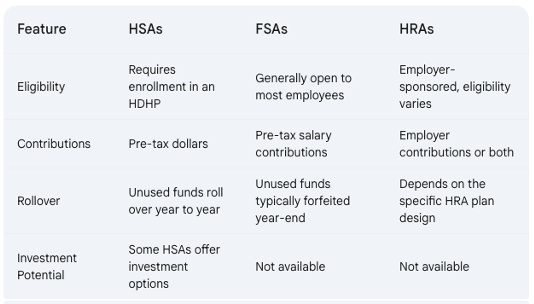
  • Health Savings Accounts (HSAs): You contribute pre-tax dollars to your HSA, which acts like a savings account dedicated to qualified medical expenses, including most over-the-counter (OTC) medications. However, to be eligible for an HSA, you must be enrolled in an High Deductible Health Plan (HDHP), which has a higher deductible than traditional health insurance plans. This means you’ll pay more out-of-pocket before your insurance kicks in. HSAs essentially act as a safety net to offset these higher deductible costs.
  • Flexible Spending Accounts (FSAs): These accounts allow you to set aside pre-tax salary contributions to cover qualified medical and dependent care expenses throughout the year. Think of it like a prepaid debit card for approved healthcare costs. Most OTC medications are eligible for reimbursement through an FSA debit card or claim submission process. Unlike HSAs, FSAs are not tied to a specific health insurance plan type, so you might have the option to contribute to an FSA even with a traditional plan (though some employers may have restrictions based on your plan selection). o FSAs have a “use it or lose it” provision: Generally, you must use the money in a FSA within the plan year (but occasionally your employer can offer a grace period of a few months).
  • Health Reimbursement Arrangements (HRAs): These employer-sponsored accounts let companies contribute funds to cover qualified employee medical expenses. The specific eligible expenses, including OTC items, vary depending on the HRA plan design set by your employer. Unlike HSAs and FSAs, you don’t directly contribute to an HRA. Instead, your employer contributes on your behalf, or in some cases, a combination of employer and employee contributions may be allowed.

Who Can Use Them?

  • HSAs: Eligibility hinges on having an HDHP.
  • FSAs: Generally available to most employees, regardless of health plan type (though some employers may restrict enrollment based on plan selection).
  • HRAs: Offered at the discretion of your employer, who determines eligibility and contribution levels.

Tax Benefits:

All three accounts offer tax advantages:

  • Contributions: Reduce your taxable income by contributing pre-tax dollars.
  • Growth:  Interest earned on the funds in HSAs and some FSAs (depending on the plan) grows tax-free, allowing your savings to accumulate faster.
  • Withdrawals: When used for qualified medical expenses, withdrawals are tax-free for all three accounts.

Key Differences:

Choosing the Right Account for You:

The best account for you depends on your individual circumstances. Here are some factors to consider:

  • Health Status: If you’re generally healthy and have predictable medical expenses, an FSA might be a good choice, allowing you to use the funds throughout the year.
  • Financial Risk Tolerance: HSAs offer long-term savings potential with rollovers and investment options (in some plans). However, they require enrollment in an HDHP, which means you’ll shoulder higher upfront costs before insurance kicks in. Consider your comfort level with potentially higher out-of-pocket expenses.
  • Employer Benefits: HRAs depend on your employer’s plan design. If your employer offers a generous HRA with significant contributions, it might be a good option for you.

Additional Considerations:

  • Use-It-or-Lose-It vs. Rollover: FSAs typically operate on a “use-it-or-lose-it” basis, so plan your contributions carefully to avoid losing funds.

Making an Informed Decision:

By thoroughly understanding HSAs, FSAs, and HRAs, you can choose the account that best aligns with your health needs, financial goals, and employer benefits, ultimately saving you money on healthcare expenses.

Compliance Recap March 2024

Compliance Recap March 2024

AFFORDABLE CARE ACT INFORMATION REPORTING

Beginning in 2024, most employers obligated to report under the Affordable Care Act (ACA) must file returns electronically by March 31, 2024. Employers filing fewer than 10 returns a year are allowed to use paper filing. Since March 31 falls on a weekend, the deadline this year is April 1, 2024.
Applicable large employers (ALEs) and smaller employers with self-insured health plans are required to e-file Forms 1095-C or 1095-B, as well as the accompanying Forms 1094-C or 1094-B, using the IRS’ Affordable Care Act Information Returns (AIR) system. Employers can apply for a 30-day extension for filing these forms by submitting Form 8809 by the original due date.

2023 HEALTH SAVINGS ACCOUNT CONTRIBUTIONS AND CORRECTIONS

For employers offering a health savings account (HSA), contributions toward the 2023 HSA limits and corrections for the 2023 calendar year must be made by April 15, 2024. Employers and employees can contribute to HSAs and make adjustments until the tax filing deadline, which is typically the individual’s tax filing due date.

Contributions that exceed the annual allowed limit are subject to a 6% tax on the excess contribution. That tax is assessed each year that the excess funds and their earnings remain in the account. Additionally, excess contributions are taxed as income.

Remember that using HSA funds for non-qualified expenses can result in significant penalties. Individuals under age 65 who use HSA money for non-qualified expenses will face a 20% penalty and pay income taxes on the withdrawal. After age 65, HSA funds may be used for non-qualified expenses without incurring the 20% penalty, however the funds will be considered taxable income.

EMPLOYER CONSIDERATIONS

Employers should ensure that employees are aware of the annual contribution limits and the deadline for contribution adjustments, as well as potential tax penalties.

PREPARING FOR JUNE PRESCRIPTION DRUG DATA (RXDC) REPORTING

The third season of Prescription Drug Data Collection (RxDC) reporting is underway, with the annual deadline set for June 1 each year, reporting on the previous calendar year. The Consolidated Appropriations Act requires all group medical plans to file a report with the Centers for Medicare & Medicaid (CMS) detailing the cost and other medical data for the group health plans’ prescription drug and other benefits, excluding excepted benefits. RxDC reporting is mandatory regardless of the group’s insurance status, size, or whether it is a grandfathered plan.

The filing must be completed electronically through the CMS Enterprise Portal. While employers are ultimately responsible for RxDC filing, most third-party administrators (TPAs) pharmacy benefit managers (PBMs) contracted to provide services to the group health plan will assist or submit filings on behalf of the group health plan.

Changes for 2024 RxDC Reporting

The average monthly premium calculation has been simplified. Instead of calculating per member per month, this is stated as the total annual premium divided by 12.

CMS has introduced restrictions on data aggregation. Data in files D1 and D3 through D8 must match the level of detail in the D2 file. This means that if the D2 data is specific to an employer’s plan, the data in files D3 through D8 must be equally specific.

EMPLOYER CONSIDERATIONS
  • Insurance carriers will handle RxDC reporting on behalf of employers with fully insured plans. However, employers should confirm with carriers that the reporting has been completed and provide any necessary information.
  • Employers with self-insured plans have final responsibility for RxDC filing. If they rely on TPAs or PBMs to assist with filing, it’s crucial to ensure that it is completed on time.
NEW YORK CITY WORKERS ALLOWED TO SUE FOR SICK LEAVE VIOLATIONS

On March 20, the New York City Council enacted a provision allowing an individual to initiate a private legal action against employers for non-compliance with the Earned Safe and Sick Time Act (ESSTA).

Individuals may now file lawsuits for alleged violations of the Act directly in court, bypassing the need to file an administrative complaint with the Department of Consumer and Worker Protection. Legal action can be initiated within two years from the date the individual became aware or should have been aware of the alleged violation and may seek penalties, injunctive and declaratory relief, legal fees, costs, and other pertinent damages against the violating entity or individual.

Under the Act, the amount of safe and sick leave provided is contingent on the size of the employer.

  • Employers with 100 or more employees are required to provide up to 56 hours of paid leave annually.
  • Employers with 5 to 99 employees must offer up to 40 hours of paid leave annually.
  • Small employers with four or fewer employees and an annual net income exceeding $1 million are obligated to provide up to 40 hours of paid leave. In contrast, if the employer’s net income is less than $1 million, they are only required to offer up to 40 hours of unpaid leave annually.
  • Employers with one or more domestic workers must provide up to 40 hours of paid leave annually, with an increase to 56 hours for employers with 100 or more domestic workers.

Eligible employees are entitled to use accrued safe and sick leave immediately, including newly hired personnel. In cases of unforeseen leave, employers cannot mandate advance notice but can request documentation for absences exceeding three consecutive workdays. Employers must provide employees with written policy details regarding safe and sick leave, including information about accrued, utilized, and total leave balances, either on paystubs or via an accessible electronic system.

Significant amendments to the were implemented on October 15, 2023, to clarify the Act:

  • The assessment of an employer’s size is based on the total number of employees nationwide, determined by the peak number of concurrently employed staff within a calendar year.
  • Full time, part-time, joint employees, and employees on leave of absence are included in the employee count for determining employer size.
  • Employees telecommuting from outside New York City are not considered employed within the city.
  • Employees based outside of New York City that are “expected to regularly perform work in New York City during a calendar year” will be counted, but only for hours worked by the employee within New York City.
EMPLOYER CONSIDERATIONS

In light of these developments, it is imperative for New York City employers to thoroughly review their safe and sick leave policies to ensure full compliance and mitigate the risk of potential litigation.

QUESTION OF THE MONTH

Q: If an employee carries her full family on a qualified high deductible health plan (QHDHP) but her children are mandated to also be enrolled in Medicaid, can she contribute the full family amount to her health savings account (HSA)?

A: If the owner of the HSA (employee) is only eligible for the HDHP and the employee has enrolled in family coverage, the employee can contribute the full family limit to the HSA even if the employee’s dependents are not otherwise eligible due to Medicaid.

Answers to the Question of the Week are provided by Kutak Rock LLP. Kutak Rock provides general compliance guidance through the UBA Compliance Help Desk, which does not constitute legal advice or create an attorney-client relationship. Please consult your legal advisor for specific legal advice.

This information is general in nature and provided for educational purposes only. It is not intended to provide legal advice. You should not act on this information without consulting legal counsel or other knowledgeable advisors.
©2024 United Benefit Advisors