Employee benefits are one of the largest investments organizations make in their people. Yet, simply offering a strong benefits package doesn’t guarantee a strong return on that investment.
The organizations that get the best return on their benefits spend understand that benefits are more than a line item on the budget. They are a tool for attracting and retaining talent, supporting employee wellbeing, improving engagement, and helping people stay productive.
The key is making sure employees understand, value, and actually use the benefits available to them.
Start With What Employees Actually Need
One of the biggest mistakes employers can make is designing benefits around assumptions rather than employee needs.
Workforces are increasingly diverse in age, family situation, financial circumstances, health needs, and career stage. A benefit that is highly valuable to one employee may be irrelevant to another. Regular employee surveys, utilization data, focus groups, and feedback from HR teams can help identify where benefits are delivering value and where there are gaps.
Instead of asking only, “What benefits should we offer?” employers should also ask:
What benefits do employees value most?
Which benefits are underused?
Why aren’t employees using them?
What challenges are employees trying to solve?
Where are employees paying for solutions outside the workplace?
Look Beyond the Cost of the Benefit
Benefits ROI shouldn’t be measured solely by how much a program costs. The bigger question is what the organization receives in return. For example, a benefits program may contribute to lower turnover, fewer unplanned absences, stronger employee engagement, or improved productivity. Those outcomes can be significantly more valuable than the cost of the benefit itself.
Consider the potential cost of replacing a valued employee. Recruiting, onboarding, training, lost productivity, and the time required for a new employee to become fully effective can add up quickly. If a well-designed benefits strategy helps retain even a small number of employees, the resulting savings may substantially offset the investment.
Make Benefits Easy to Understand
A benefit employees don’t understand is a benefit they may never use.
Benefits can be complicated. Employees may struggle to understand insurance options, retirement plans, wellness programs, voluntary benefits, leave policies, or other offerings. When information is buried in a handbook or presented once during open enrollment, employees can easily miss its value.
Effective benefits communication should be:
Simple: Explain benefits in clear, everyday language.
Timely: Provide information when employees are most likely to need it.
Accessible: Make information easy to find throughout the year.
Relevant: Tailor communications to different employee needs and life stages.
Communication shouldn’t be treated as an annual event. Benefits should remain visible and relevant throughout the employee experience.
Measure Utilization and Outcomes
You can’t improve benefits ROI if you don’t measure it. Employers should regularly review metrics such as enrollment, participation, utilization, employee satisfaction, turnover, absenteeism, and healthcare spending.
For example, if an employee assistance program has low participation, the answer isn’t necessarily to eliminate it. Low usage could indicate that employees don’t know about the program, don’t understand how confidential it is, or don’t know when they should use it.
Similarly, high utilization isn’t automatically a sign that a program is successful. Employers should consider whether the benefit is producing the outcomes it was intended to achieve. The goal is to move from measuring benefit activity to measuring business impact.
Optimize Your Existing Benefits Before Adding More
More benefits don’t necessarily mean better benefits.
Before adding another program, employers should evaluate whether existing offerings are being fully utilized. A benefits package can become unnecessarily expensive and confusing when new programs are continually added without evaluating older ones.
A periodic benefits audit can identify:
Programs with consistently low participation.
Overlapping or redundant offerings.
Benefits that employees don’t understand.
Opportunities to improve employee communication.
Programs that no longer align with workforce needs.
Sometimes the best way to improve ROI isn’t to spend more–it’s to make better use of what you already have.
Treat Benefits as Part of Your Talent Strategy
Benefits shouldn’t operate in isolation from recruiting, retention, culture, and employee experience. Candidates evaluate the entire employment package when deciding where to work. Employees also consider benefits when deciding whether to stay. A competitive benefits package can help answer an important employee question: “Why should I build my career here?”
The strongest approach combines four elements: Understand your employees. Communicate effectively. Measure results. Optimize benefits.
Getting the best ROI from benefits isn’t simply about reducing costs or adding more programs. It’s about making strategic decisions about where benefits dollars can have the greatest impact.
Cancer has evolved into a persistent and complex challenge that demands a proactive approach rather than a reactive one. With more employees being diagnosed at younger ages and the cost of advanced treatments accelerating, cancer has solidified its position as a primary driver of healthcare spending for organizations. According to the Business Group on Health’s 2026 survey, 58% of employers identify cancer as their leading cost factor, while 74% report an increase in cancer prevalence within their own workforces.
The Expanding Financial Burden
The economic impact of cancer now extends far beyond traditional medical claims. While rising pharmacy costs—particularly for oncology medications—are a significant contributor to annual budget increases, employers are also absorbing substantial indirect costs. These include short- and long-term disability claims, lost productivity, “presenteeism“among employees managing their own care or supporting ill family members, and the strain of increased mental health service utilization. Furthermore, the timing of care is critical; research indicates that diagnosing cancer even one stage earlier can save approximately $60,000 per patient, underscoring the financial value of early detection.
Key Trends Reshaping the Landscape
Three primary forces are transforming how cancer impacts the workplace:
Innovations in Precision Medicine: While genomic testing, immunotherapies, and gene therapies have drastically improved survival rates, they come with high price tags—sometimes exceeding $500,000 per treatment course. The challenge for employers is managing access to these life-saving innovations without compromising quality or financial sustainability.
Rising Diagnoses in Younger Adults: An increasing number of cancer cases are occurring in individuals under 50. This shift, combined with a significant gap in preventive screenings during the COVID-19 pandemic, means more employees are presenting with advanced-stage diagnoses.
The Shift to Chronic Condition Management: Medical success has turned cancer into a manageable condition for many, meaning employees may live with cancer for years. This requires employers to rethink benefits, as they must now support survivors who require long-term follow-up care, mental health support, and accommodations for lingering treatment side effects.
Proactive Strategies for Benefit Design
To stay ahead of these trends, employers are moving beyond standard coverage to implement more strategic, holistic support systems:
Prioritize Prevention: Incentivizing early screenings is the most cost-effective way to mitigate long-term expenses.
Utilize Centers of Excellence (COE): Steering employees toward specialized, high-volume oncology centers ensures better outcomes and reduces treatment variation.
Strengthen Precision Medicine Policies: Partnering with consultants to establish evidence-based coverage for genomic testing and targeted therapies enabling employees to receive more personalized, effective care while minimizing unnecessary trial-and-error treatments.
Bridge Support Gaps: While most employer-sponsored plans offer cancer adjacent resources – such as mental health services through Employee Assistance Programs (EAPs), disability coverage, and basic care navigation – these solutions fall short of the complex, individual needs to cancer patients and survivors. Mental health support is rarely tailored to oncology-related challenges, and return-to-work programs often overlook the physical effect of treatment. More comprehensive support can include cancer-specific navigation programs, second-opinion services, and return-to-work planning.
Leverage Data for Better Decisions: Using claims and screening data helps employers identify key areas of need and focus interventions where they can make the greatest difference.
The landscape of cancer care requires a fundamental shift in mindset: employers must transition from being reactive payers to becoming proactive health partners. By combining high-quality treatment access with holistic employee support, organizations can better manage the economic burden while providing essential care during their employees’ most challenging times.
An FSA is an employer-sponsored, tax-advantaged savings account. It allows you to set aside “pre-tax” money—meaning the money is taken out of your paycheck before taxes are calculated—to pay for out-of-pocket healthcare and dependent-care expenses. The Bottom Line: Because you aren’t paying taxes on this money, you effectively lower your taxable income and increase your spending power for health needs.
Tax Savings: Pre-tax contributions save you money on every dollar.
Employer-Based: You must work for a company that offers an FSA to participate.
Use It or Lose It: Most funds must be spent within the plan year, though some plans offer small rollovers or grace periods.
How It Works
Your chosen contribution amount is divided across your yearly paychecks and deducted automatically. The Federal FSA Program estimates that those with an FSA save 30 percent on healthcare expenses on average.
What Can You Buy With an FSA?
Beyond doctor’s visits and hospital fees, you can also use your FSA funds for:
Everyday Care: Band-aids, bandages, sunscreens, and menstrual care products.
Diagnostics: Blood pressure monitors, cholesterol test kits, and thermometers.
Therapy: Acupuncture and chiropractic care.
Family Planning: Birth control and pregnancy tests.
The Pros and Cons
The Benefits
Instant Tax Break: Your federal and employment taxes are lowered immediately.
Day-to-Day Savings: Covers “hidden” costs like sunscreen, first aid kits, and over-the-counter meds.
Upfront Funding: With a Healthcare FSA, your full annual amount is usually available on Day 1 of the plan year.
The Limitations
Not Portable: If you leave your job, you generally lose the account.
Strict Deadlines: Most plans require you to spend the balance by Dec 31st (check if your plan allows a $680 rollover or a 2.5-month grace period).
No Investing: Unlike an HSA, FSA funds do not earn interest or grow in the stock market.
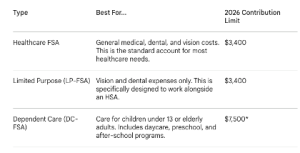
Exploring the Different Types of FSAs
Not all FSAs are the same. Depending on your needs, your employer might offer:
*Note: For the Dependent Care FSA, the limit is $3,750 if you are married and filing taxes separately.
Is an FSA Right for You?
Opening an FSA is a great way to save money on taxes and prepare for healthcare costs. As with other types of savings accounts, it allows you to contribute and stash away money, but in this case, that money is taken out of your paychecks in a set amount and is nontaxable. Check to see if your employer matches contributions as well.
Understanding the rules, benefits, and limitations of these accounts will allow you to maximize their value and ensure you’re making the most of this employee benefit.
As the modern workforce evolves, employer-sponsored benefits must adapt to meet changing demographic demands. Women comprise nearly half of the U.S. workforce and are its primary consumers of healthcare services. Today, standard health coverage is shifting away from a pregnancy-only lens to an inclusive, whole-life framework.
The Evolution to Whole-Life Care
Historically, corporate maternal care focused strictly on a brief window: prenatal visits, delivery, and basic postpartum recovery. Today, organizations recognize that pregnancy is just one phase of a lifelong health journey. A comprehensive benefits framework accounts for every stage of a career:
Preconception and fertility planning.
Pregnancy, high-risk maternity care, and comprehensive postpartum support.
Menstrual health and chronic reproductive conditions (e.g., endometriosis).
Midlife career transitions, including perimenopause and menopause.
Chronic conditions that disproportionately impact women, such as autoimmune disorders and bone health issues.
4 Key Trends Transforming Corporate Benefits
Universal Fertility and Family-Building Support
With one in eight couples facing challenges conceiving or sustaining a pregnancy, family-building benefits have shifted from a perk to a baseline recruitment tool. Two-thirds of employers plan to invest heavily in family health benefits over the next three years—a 44% increase compared to 2024. These initiatives provide crucial financial assistance for complex, high-cost treatments like in vitro fertilization (IVF), egg freezing, and surrogacy.
Specialized Maternal Health Interventions
Millennials now make up the largest segment of the workforce (36%), placing them at peak childbearing age. Because maternity costs have escalated by 50% over the last decade and 57% of benefits leaders report a rise in high-risk pregnancies, timely intervention is critical.
Providing digital care navigation reduces high-risk maternal journeys by 61%, significantly lowering claims costs. Holistic organizations are also expanding care beyond delivery to include doula services, postpartum mental health screenings, and lactation support to ease the return-to-work transition.
Critical Support for Menopause and Midlife Care
Menopausal women represent nearly 30% of the domestic workforce, yet fewer than 15% of organizations offer menopause-specific benefits. Symptoms like cognitive fatigue, sleep disruptions, and hot flashes cost employers an estimated $1.8 billion annually in lost work time.
Generation X workers are actively advocating for medical support, including hormone replacement therapy (HRT), especially as primary care training in menopause remains low.
Changes to the Legal Landscape
The regulatory environment surrounding reproductive health is changing rapidly. Federal directives have introduced drug pricing reforms for fertility medications and established new pathways for employers to offer standalone fertility benefits as “excepted benefits” outside traditional group health plans. Concurrently, over 20 states now mandate private insurance coverage for fertility treatments.
On the postpartum front, the federal PUMP Act has expanded lactation rights to nine million more workers by requiring private, non-bathroom spaces for expressing milk. Additionally, a wave of updated state leave laws is expanding access to family and sick leave across all life stages.
Actionable Strategic Playbook for Employers
To support women in the workforce and optimize healthcare spending, employers can consider the following five strategies:
Design Around Life Stages: Use integrated digital health platforms to provide a continuum of care from preconception to menopause, reducing fragmented solutions and administrative burdens.
Prioritize Preventive Care: Encourage early diagnostic intervention for high-risk pregnancies, fertility challenges, and midlife transitions to avoid complex, high-cost claims later.
Embed Mental Health Across All Coverage: Ensure dedicated clinical support is available for underdiagnosed struggles, including fertility-related grief, postpartum depression, and general anxiety.
Proactively Drive Utilization: Frequently and clearly communicate benefit options so employees know how to utilize resources before a health crisis occurs.
Measure Outcomes: Look beyond basic enrollment numbers. Evaluate return-to-work rates, employee satisfaction, and claims reductions over time. Utilizing analytics can help HR teams identify specific usage gaps and target early interventions.
Making benefits easy for employees to access and understand is just as important as offering the right benefits package. By simplifying benefit information and communicating it regularly, employers can improve employee satisfaction and help ensure employees receive the healthcare support they need.
Many people put off seeking medical care, even when they recognize that something doesn’t feel right. Busy schedules, financial concerns, fear of receiving bad news, and the hope that symptoms will simply go away often lead to delays that can allow health problems to worsen. While postponing care may seem like the easier choice in the moment, understanding the common reasons behind these decisions is the first step toward making more informed health choices.
Common Reasons for Delaying Care
Many individuals postpone healthcare for a variety of reasons:
Cost Concerns: Approximately 36% of U.S. adults have delayed care due to costs, often leading to difficult sacrifices like skipping meals or utilities to afford medical expenses.
High Deductibles: Many insured individuals find high deductibles unaffordable, causing them to avoid non-preventive care until they have already met their deductible or require major medical services.
Scheduling Barriers: Busy personal and professional schedules can make it difficult to find appointments that align with provider availability.
Minimized Symptoms: People may downplay their symptoms to avoid the anxiety of a diagnosis or the inconvenience of the healthcare system.
Coverage Confusion: A lack of understanding regarding what a health plan covers can cause people to avoid care out of fear of unexpected bills.
The Risks of Postponing Treatment
Avoiding care rarely saves money and frequently allows manageable issues to evolve into serious conditions. According to a survey commissioned by Nice Healthcare, the consequences of delaying care include:
Increased Stress: Over one-third (38%) of respondents reported that increased anxiety and stress were the primary results of delaying medical attention.
Persistent Symptoms: More than one-quarter (29%) of individuals experienced symptoms that lasted longer than anticipated or reported reduced energy levels that negatively impacted work performance.
Worsened Conditions: Approximately one-fifth (21%) of respondents noted that their condition became more serious as a result of the delay.
Impacted Productivity: Among millennials, 30% reported needing more time off work after delaying care, indicating that the “push through it” mindset often leads to lost productivity and increased sick days.
Strategies to Take Charge of Your Health
To maximize your benefits and prevent future complications, consider these proactive steps:
Prioritize Preventive Care: Most plans cover annual wellness visits at no cost, providing a cost-effective way to address issues early.
Understand Your Coverage: Review your Summary of Benefits and Coverage (SBC) to understand your costs for specialists, prescriptions, and mental health services.
Leverage Modern Tools: Utilize telehealth for convenient access to providers and use insurance cost estimator tools to reduce financial uncertainty before receiving care.
Find In-Network Providers: Use your member portal to identify in-network specialists and labs to avoid paying higher out-of-pocket costs associated with out-of-network providers.
Utilize Support Programs: Take advantage of Employee Assistance Programs (EAPs), which offer confidential support for mental health, financial challenges, and stress-related issues.
By familiarizing yourself with your health benefits, you can make informed decisions that protect both your physical well-being and your financial stability.
In today’s workforce, a significant number of experienced employees are working a second job that never appears on a timesheet: caregiving. This places them in the “sandwich generation,” a group of middle-aged adults tasked with simultaneously caring for their aging parents and their own children. This isn’t a specific age cohort like the Baby Boomers, but rather a challenging phenomenon that can affect anyone whose parents and children require support at the same time.



 Many people put off seeking medical care, even when they recognize that something doesn’t feel right. Busy schedules, financial concerns, fear of receiving bad news, and the hope that symptoms will simply go away often lead to delays that can allow health problems to worsen. While postponing care may seem like the easier choice in the moment, understanding the common reasons behind these decisions is the first step toward making more informed health choices.