by admin | Aug 18, 2017 | COBRA, Human Resources
The Consolidated Omnibus Budget Reconciliation Act of 1985 (COBRA) allows qualified beneficiaries who lose health benefits due to a qualifying event to continue group health benefits. While some group health plans may provide COBRA continuation coverage at a reduced rate or at no cost, most qualified beneficiaries must pay the full COBRA premium. The COBRA election notice should include information about COBRA premiums.
For fully insured health plans, the premium is the cost to maintain the plan for similarly situated employees. For self-funded plans, the premium is the cost to maintain the plan for similarly situated employees as determined by an actuary or the past cost from the preceding determination period. The applicable premium calculation for both fully- and self-funded plans includes the cost of providing coverage to both active employees and COBRA qualified beneficiaries. All COBRA premiums must be calculated in good faith compliance with a reasonable interpretation of COBRA requirements.
Generally, COBRA payments are made on an after-tax basis. Qualified beneficiaries have 45 days after the election date to make an initial premium payment. The plan may terminate the qualified beneficiary’s COBRA rights if no initial premium payment is made before the end of the 45-day period. In addition, plans must allow monthly premium payments and cannot require payment on a quarterly basis. As established under COBRA, premiums are due on the first day of each month with a minimum 30-day grace period. A plan may terminate COBRA coverage for nonpayment or insufficient payment of premiums after the grace period.
If a qualified beneficiary makes an insignificant underpayment, then the premium payment will still satisfy the payment obligation. An underpayment is deemed insignificant if the shortfall is no greater than the lesser of $50 or 10 percent of the required amount. However, if the plan notifies the qualified beneficiary of the shortfall and grants a reasonable amount of time to correct the underpayment (usually 30 days after the notice is provided), then the qualified beneficiary is required to make the payment; otherwise, COBRA coverage may be canceled.
Fully Insured Health Plans
Generally, the applicable COBRA premium amount for fully insured plans is the insurance premium charged by the insurer. The applicable premium is based on the total cost of coverage, which includes both the employer and employee portions. The premium amount is based on the cost of coverage for similarly situated individuals who have not incurred a qualifying event.
A group health plan may charge at most 102 percent of the premium during the standard COBRA coverage period for similarly situated plan participants (100 percent of the total cost of coverage plus an additional 2 percent for administrative costs). However, the plan may increase the premium for a disabled qualified beneficiary and charge 150 percent of the applicable premium during the 11-month disability extension period (months 19 through 29). In addition, COBRA regulations permit a plan to charge a 150 percent premium to nondisabled qualified beneficiaries as long as the disabled qualified beneficiary is covered under the plan. If the disabled qualified beneficiary is no longer covered under the plan, then the remaining qualified beneficiaries may continue coverage up to 29 months at 102 percent of the cost of the plan.
If an employer maintains more than one plan, then a separate applicable premium is calculated for each plan. Also, the applicable premium for a single plan may vary due to factors such as the coverage level, the benefit package, and the region in which covered employee resides. For instance, single employees may pay a different applicable premium than employees who include their spouse on the plan. Thus, the plan may charge different premiums based on the varying coverage levels.
The most common tier structures include employee-only, employee-plus-spouse, employee-plus-children, and employee-plus-family. According to Internal Revenue Ruling 96-8, a fully insured plan that pays different premiums for individual versus family coverage must use those same premium tiers for COBRA continuation coverage. Thus, COBRA premiums are divided into multi-rate and single-rate tier structures.
By Danielle Capilla
Originally Published By United Benefit Advisors

by admin | Aug 15, 2017 | Compliance, Health & Wellness
Where to Start?
First, expand the usual scope of wellness activity to well-BEING. Include initiatives that support more than just physical fitness, such as career growth, social needs, financial health, and community involvement. By doing this you increase your chances of seeing a return on investment (ROI) and a return on value (ROV). Qualitative results of a successful program are just as valuable as seeing a financial impact of a healthier population.
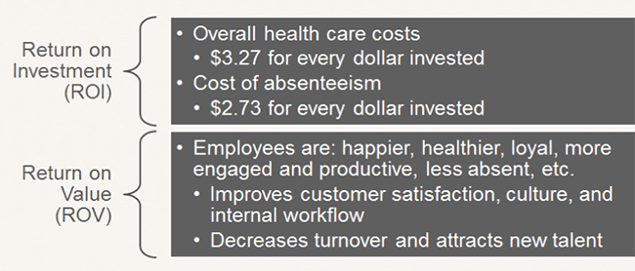
Source: Katherine Baicker, David Cutler, and Zirui Song, “Workplace Wellness Programs Can Generate Savings,” Health Affairs, February 2010, 29(2): pp 304-311
To create a corporate culture of well-being and ensure the success of your program, there are a few important steps.
- Leadership Support: Programs with leadership support have the highest level of participation. Gain leadership support by having them participate in the programs, give recognition to involved employees, support employee communication, allow use of on-site space, approve of employees spending time on coordinating and facilitating initiatives, and define the budget. Even though you do not need a budget to be successful.
- Create a Committee or Designate a Champion: Do not take this on by yourself. Create a well-being committee, or identify a champion, to share the responsibility and necessary actions of coordinating a program.
- Strategic Plan: Create a three-year strategic plan with a mission statement, budget, realistic goals, and measurement tools. Creating a plan like this takes some work and coordination, but the benefits are significant. You can create a successful well-being program with little to no budget, but you need to know what your realistic goals are and have a plan to make them a reality.
- Tools and Resources: Gather and take advantage of available resources. Tools and resources from your broker and/or carrier can help make managing a program much easier. Additionally, an employee survey will help you focus your efforts and accommodate your employees’ immediate needs.
How to Remain Compliant?
As always, remaining compliant can be an unplanned burden on employers. Whether you have a wellness or well-being program, each has their own compliance considerations and requirements to be aware of. However, don’t let that stop your organization from taking action.
There are two types of programs – Group Health Plans (GHP) and Non-Group Health Plans (Non-GHP). The wellness regulations vary depending on the type of employer and whether the program is considered a GHP or Non-GHP.
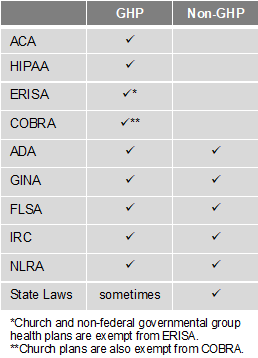
Employers looking to avoid some of the compliance burden should design their well-being program to be a Non-GHP. Generally, a well-being program is Non-GHP if it is offered to all employees regardless of their enrollment in the employer’s health plan and does not provide or pay for “medical care.” For example, employees receive $100 for attending a class on nutrition. Here are some other tips to keep your well-being program Non-GHP:
- Financial: Do not pay for medical services (e.g., flu shots, biometric screenings, etc.) or provide medical care. Financial incentives or rewards must be taxed. Do not provide premium discounts or surcharges.
- Voluntary Participation: Include all employees, but do not mandate participation. Make activities easily accessible to those with disabilities or provide a reasonable alternative. Make the program participatory (i.e., educational, seminars, newsletters) rather than health-contingent (i.e., require participants to get BMI below 30 or keep cholesterol below 200). Do not penalize individuals for not participating.
- Health Information: Do not collect genetic data, including family medical history. Any medical records, or information obtained, must be kept confidential. Avoid Health Risk Assessments (i.e. health surveys) that provide advice and analysis with personalized coaching or ask questions about genetics/family medical history.
By Hope DeRocha
Originally Posted By www.ubabenefits.com

by admin | Aug 10, 2017 | Employee Benefits, Human Resources
Death and loss touch all of us, usually many times throughout our lives. Yet we may feel unprepared and uncomfortable when grief intrudes into our daily routines. As a manager, when grief impacts your employees it’s helpful to have a basic understanding of what they are going through as well as ways you can help.
Experiencing Grief
Although we all experience grief in our own way, there are behaviors, emotions and physical sensations that are a common part of the mourning process. J. William Worden’s “Four Tasks of Mourning” will be experienced in some form by anyone who is grieving. These tasks include accepting the reality of the loss, experiencing and accepting our emotions, adjusting to life without the loved one, and investing emotional energy into a new and different life.
Commonly experienced emotions are sadness, anger, frustration, guilt, shock and numbness. Physical sensations include fatigue or weakness, shortness of breath, tightness in the chest and dry mouth.
Manager’s Role
When employees are mourning, it’s important to create a caring, supportive and professional work environment. In most cases, employees will benefit from returning to work. It allows them to resume a regular routine, focus on something besides their loss and boost their confidence by completing work tasks.
At the same time, bereaved employees may experience many challenges when returning to work. They may have poor concentration, be extremely tired, feel depressed or have a short temper and uncontrollable emotions.
As a manager, the best thing you can do is acknowledge the loss and maintain strong lines of communication. Even if you believe someone else is checking in with them, make sure you stay in touch and see if there is anything you can do.
Developing a Return to Work Plan
In order to help your employees have a smooth transition back to work you must listen and understand their needs. Some additional questions you’ll want to answer are:
- What are your company’s policies and procedures for medical and bereavement leave?
- What information do your employees want their co-workers to have and would they rather share this information themselves?
- Do they want to talk about their experience or would they rather focus on work?
- Do they need private time while at work?
- Does their workload and schedule need to be adjusted?
- Do they need help at home – child care, meals, house work, etc.?
- Are there others at work that may be experiencing grief of their own?
Helpful Responses for Managers
- Offer specific help – make meals, wash their car, walk their pet, or anything else that will make their life easier.
- Say something – it can be as simple as, “I’m so sorry for your loss.”
- Listen – be kind but honest.
- Respect privacy – honor closed doors and private moments.
- Expect tears – emotions can hit unexpectedly.
- Thank your staff – for everything they are doing to help.
Grieving is a necessity, not a weakness. It is how we heal and move forward. As a manager, being there for your employees during this time is important in helping them through the grieving process.
An Employee Assistance Program is a great resource for both you and your employees when grief comes to work.
By Kathyrn Schneider
Originally Posted By www.ubabenefits.com
by admin | Aug 4, 2017 | HSA/HRA
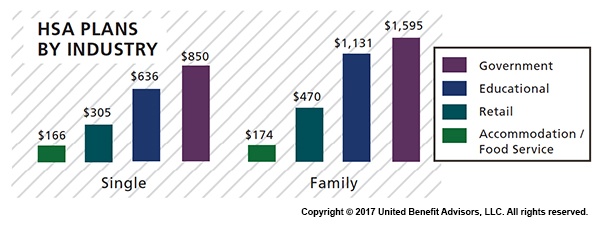
Across most industries, HSA contributions are, for the most part, down or unchanged from three years ago, according to UBA’s Health Plan Survey. The average employer contribution to an HSA is $474 for a single employee (down 3.5 percent from 2015 and 17.6 percent from five years ago) and $801 for a family (down 9.2 percent from last year and 13.7 percent from five years ago). Government and education employers are the only industries with average single contributions well above average and on the rise.
Government employees had the most generous contributions for singles at $850, on average, up from $834 in 2015. This industry also has the highest employer contributions for families, on average, at $1,595 (though that is down from 1,636 in 2015). Educational employers are the next most generous, contributing $636, on average, for singles and $1,131 for families.
Singles in the accommodation/food services industries received virtually no support from employers, with average HSA contributions at $166. The same is true for families with HSA plans in the accommodation/food services industries with average family contributions of $174.
Retail employers also remain among the least generous contributors to single and family HSA plans, contributing $305 and $470, respectively. This may be why they have low enrollment in these plans.
The education services industry has seen a 109 percent increase in HSA enrollment since 2013 (aided by employers’ generous contributions), catapulting the industry to the lead in HSA enrollment at 23.8 percent. The professional/scientific/tech and finance/insurance industries follow closely at 23.3 percent and 22.1 percent, respectively.
The mining/oil/gas industry sees the lowest enrollment at 3.8 percent. The retail, hotel, and food industries continue to have some of the lowest enrollment rates despite the prevalence of these plans, indicating that these industries, in particular, may want to increase employee education efforts about these plans and how they work.
For a detailed look at the prevalence and enrollment rates among HSA and HRA plans by group size and region, view UBA’s “Special Report: How Health Savings Accounts Measure Up”.
Benchmarking your health plan with peers of a similar size, industry or geography makes a big difference in determining if your plan is competitive. To compare your exact plan with your peers, request a custom benchmarking report.
For fast facts about HSA and HRA plans, including the best and worst plans, average contributions made by employers, and industry trends, download (no form!) “Fast Facts: HSAs vs. HRAs”.
By Bill Olson
Originally Posted By www.ubabenefits.com

by admin | Jul 31, 2017 | COBRA, Human Resources
The Consolidated Omnibus Budget Reconciliation Act of 1985 (COBRA) requires group health plans to provide notices to covered employees and their families explaining their COBRA rights when certain events occur. The initial notice, also referred to as the general notice, communicates general COBRA rights and obligations to each covered employee (and his or her spouse) who becomes covered under the group health plan. This notice is issued by the plan administrator within the first 90 days when coverage begins under the group health plan and informs the covered employee (and his or her spouse) of the responsibility to notify the employer within 60 days if certain qualifying events occur in the future.
The initial notice must include the following information:
- The plan administrator’s contact information
- A general description of the continuation coverage under the plan
- An explanation of the covered employee’s notice obligations, including notice of
- The qualifying events of divorce, legal separation, or a dependent’s ceasing to be a dependent
- The occurrence of a second qualifying event
- A qualified beneficiary’s disability (or cessation of disability) for purposes of the disability extension)
- How to notify the plan administrator about a qualifying event
- A statement that the notice does not fully describe continuation coverage or other rights under the plan, and that more complete information regarding such rights is available from the plan administrator and in the plan’s summary plan description (SPD)
As a best practice, the initial notice should also:
- Direct qualified beneficiaries to the plan’s most recent SPD for current information regarding the plan administrator’s contact information.
- For plans that include health flexible spending arrangements (FSAs), disclose the limited nature of the health FSA’s COBRA obligations (because certain health FSAs are only obligated to offer COBRA through the end of the year to qualified beneficiaries who have underspent accounts).
- Explain that the spouse may notify the plan administrator within 60 days after the entry of divorce or legal separation (even if an employee reduced or eliminated the spouse’s coverage in anticipation of the divorce or legal separation) to elect up to 36 months of COBRA coverage from the date of the divorce or legal separation.
- Define qualified beneficiary to include a child born to or placed for adoption with the covered employee during a period of COBRA continuation coverage.
- Describe that a covered child enrolled in the plan pursuant to a qualified medical child support order during the employee’s employment is entitled to the same COBRA rights as if the child were the employee’s dependent child.
- Clarify the consequences of failing to submit a timely qualifying event notice, timely second qualifying event notice, or timely disability determination notice.
Practically speaking, the initial notice requirement can be satisfied by including the general notice in the group health plan’s SPD and then issuing the SPD to the employee and his or her spouse within 90 days of their group health plan coverage start date.
If the plan doesn’t rely on the SPD for furnishing the initial COBRA notice, then the plan administrator would follow the U.S. Department of Labor (DOL) rules for delivery of ERISA-required items. A single notice addressed to the covered employee and his or her spouse is allowed if the spouse lives at the same address as the covered employee and coverage for both the covered employee and spouse started at the time that notice was provided. The plan administrator is not required to provide an initial notice for dependents.
By Danielle Capilla
Originally Posted By www.ubabenefits.com