Work and family are two of the most important parts of an employee’s life. But starting or growing a family doesn’t always happen easily. According to the World Health Organization, about one in six people experience fertility challenges, making the path to parenthood stressful, complex and often expensive. Not surprisingly, these challenges can spill over into the workplace. Research shows that many employees spend time during work hours exploring treatment options and benefits, and more than half report that fertility struggles have negatively affected their job performance.
Fertility-related stress is a key driver of presenteeism—when employees are physically at work but less productive due to personal concerns. This not only affects morale and engagement but also carries a significant financial cost. Estimates suggest presenteeism costs U.S. businesses far more than absenteeism each year. Employers that offer fertility benefits often see higher engagement, improved productivity and stronger long-term retention.
Understanding Infertility
Infertility has been classified as a disease since 2017 and is generally defined as the inability to conceive after a year of trying without contraception. It affects both men and women and is often difficult to detect because symptoms aren’t always obvious.
Primary vs. Secondary: Whether an employee is trying for their first child or adding to their family, also known as secondary infertility, the stress remains the same.
Medical Drivers: Common reasons for seeking care include ovulation disorders, uterine fibroids, endometriosis, genetic screening, and fertility preservation, such as before chemotherapy.
Because these conditions affect employees throughout various life stages, employers who offer fertility coverage can appeal to a wide demographic and enhance retention across their workforce.
The Financial Reality of Care
The “financial toxicity” of infertility is a major stressor for the workforce:
Price Tag: A single IVF cycle can exceed $30,000, yet only 32% of individuals can afford treatment without assistance. Multiple cycles are often required to achieve pregnancy.
Debt & Sacrifice: To afford care, employees often go into significant debt, dip into retirement savings, or take second jobs—all of which fuel workplace burnout and distraction.
Common Benefit Offerings
Employers can leverage several strategies to support their team, depending on budget and goals:
Clinical Procedures: Covering IVF, such as egg retrieval and transfer, or IUI, also known as artificial insemination.
Surgical Interventions: Procedures to resolve physical barriers like cysts or fallopian tube issues.
Pharmaceutical Support: Medications to stimulate ovulation or improve counts.
Navigation & Coaching: Providing access to specialized platforms to help employees find high-quality, cost-effective care.
Why Fertility Benefits Matter
Because most states do not mandate fertility coverage for private insurers, employer-sponsored fertility benefits can make a meaningful difference. They reduce financial stress and promote emotional well-being.
Fertility challenges can take a toll on employees’ emotional well-being, finances and job performance. By offering meaningful fertility benefits, employers can reduce these burdens while improving productivity, engagement and satisfaction. At the same time, these benefits help organizations stand out in a competitive labor market, supporting both talent attraction and long-term retention.
In the world of employee benefits, we often spend our time talking about what happens when things go wrong—surgeries, emergency room visits, and specialist consultations. Today, the most successful organizations are shifting the conversation toward what happens when things go right.
Teaching your employees about preventive care is more than just a wellness initiative; it is a strategic financial move. By encouraging your team to use the “maintenance” features of their health plans, you reduce long-term claims, decrease absenteeism, and—most importantly—keep your people healthy.
Why Education Matters (The “Why”)
Many employees avoid the doctor because they fear the cost. They don’t realize that under most modern health plans, preventive services are covered at 100%, with no deductible or copay required.
When employees understand this “first-dollar coverage,” they stop waiting for symptoms to appear and start catching issues while they are small, manageable, and inexpensive. A $0 annual checkup can catch high blood pressure before it becomes a $50,000 heart attack. Education is the bridge between having a benefit and actually using it.
Types of Preventive Care: What’s Included?
When educating your staff, it helps to categorize preventive care into “The Big Three.” Most of these services are available at no additional cost to the employee:
1. Screenings & Physicals
Annual Wellness Exams: A comprehensive check-in to monitor vitals and establish a health baseline.
Cancer Screenings: Age-appropriate screenings such as mammograms, colonoscopies, and pap smears.
Biometric Screenings: Checks for cholesterol, blood sugar (diabetes), and blood pressure.
2. Immunizations & Medications
Routine Vaccines: Coverage for the flu shot, Tetanus, Shingles, and COVID-19 boosters.
Preventive Medications: Many plans cover certain “preventive” drugs (like statins or low-dose aspirin) at a lower cost or even $0 to manage chronic conditions before they escalate.
3. Family & Mental Well-being
Pediatric Care: Well-child visits and standard childhood immunizations.
Prenatal Care: Routine checkups for expecting mothers to ensure a healthy pregnancy.
Mental Health Screenings: Depression and anxiety screenings are increasingly recognized as essential preventive care in 2026.
How to Encourage Utilization
Knowing isn’t the same as doing. Here is how employers can drive action:
Remove the Time Barrier: Offer “Wellness Hours”—a few hours of paid time off specifically for employees to attend their annual physicals or screenings.
Simplify the Search: Provide a direct link to your carrier’s “Find a Doctor” tool, specifically filtered for primary care physicians.
Incentivize the Checkup: Some companies offer a small HSA contribution or a premium discount for employees who complete an annual biometric screening.
Use Real-World Messaging: Instead of a complex brochure, send a quick email: “Did you know your annual flu shot and physical are $0? Here is where you can go locally to get them done.”
A “health literate” workforce is a more resilient workforce. When employees understand that preventive care is a free tool designed to keep them out of the hospital, everyone wins. You aren’t just managing a plan; you’re fostering a culture where health is a priority, not a reaction.
Navigating the healthcare system is rarely a straight line. Between deciphering insurance jargon and choosing the right doctor, the decisions you make have a direct impact on your physical health and your bank account. As healthcare costs continue to rise—ranking as a top economic concern for two-thirds of Americans—personal health literacy has become an essential survival skill. It isn’t about having a medical degree; it’s about having the practical “know-how” to find, understand, and actually use health information to your advantage.
The Four Levels of Health Literacy
Proficient: Can navigate complex systems, follow intricate treatment plans, and choose the most effective care.
Intermediate: Can handle moderately complex documents and draw reasonable conclusions.
Basic: Can manage simple tasks (like reading a brochure) but struggles with complex insurance or medical concepts.
Below Basic: Struggles to navigate the healthcare environment beyond simple hospital forms.
How Health Literacy Saves You Money
Choosing the Right Setting: Why pay ER prices for a minor flu? Literacy helps you distinguish when to use Telehealth or Urgent Care versus the Emergency Room.
Mastering the Network: Avoiding “out-of-network” surprises by proactively verifying provider status before you show up for an appointment.
Decoding the Jargon: Understanding basic terms like deductibles, coinsurance, and out-of-pocket maximums so you can predict expenses and optimize your coverage.
Managing Medications: Knowing how to ask for generics or 90-day supplies, and understanding instructions to avoid costly complications or repeat visits.
Using Preventive Care: Many plans offer vaccinations and screenings at no cost. High health literacy ensures you use these benefits to catch issues before they become expensive emergencies.
Maximizing Tax Savings: Effectively using HSAs and FSAs to pay for medical needs with pre-tax dollars.
Effective Communication: Asking the right questions during a doctor’s visit to avoid unnecessary tests or duplicate referrals.
The 2-Minute Health Literacy Challenge
Test your “Health IQ” and see if you’re ready to save in 2026!
You have a $1,500 deductible… A) $0 B) $500 C) $1,000
Which account rolls over? A) FSA B) HSA C) Both
Nasty cough, sore throat… A) ER B) Telehealth/Retail Clinic C) Specialist
True or False: In-Network means discounted rates. A) True B) False
Non-life-threatening injury on Saturday… A) Urgent Care B) Telehealth C) ER
Tier 3 drug cost… A) Cheap generic B) Expensive brand/non-preferred C) Not covered
Check Your Answers
C ($1,000). Since you haven’t hit your $1,500 deductible yet, you are responsible for the full cost of the procedure until that “starting line” is met.
B (HSA). HSAs are yours for life. FSAs are generally “use-it-or-lose-it” by the end of the year.
B (Telehealth/Retail Clinic). For non-emergencies, these settings are significantly cheaper and faster than the ER.
A (True). Staying in-network is the easiest way to avoid “surprise bills” and high coinsurance rates.
C. The ER is designed for life-or-death situations. Because it is staffed 24/7 with specialists, the “base price” just to walk through the door is often 5x–10x higher than an Urgent Care or Telehealth visit.
B. Formularies are usually tiered 1 through 4. Tier 1 is the cheapest (generics), while Tier 3 and 4 are the most expensive (specialty/brands). Knowing your tiers helps you ask for a “Tier 1 alternative.”
Choosing a health insurance plan can feel a lot like solving a puzzle—there are many moving pieces, and the best fit depends on how they come together for your unique situation. With so many options and acronyms—HMO, PPO, POS, EPO, HDHP—it’s easy to feel unsure about where to start. This guide breaks down the most common types of health plans to help you understand how they work, what they cost, and which one might align best with your health care needs and budget.
What Sets Health Plans Apart
When comparing plans, pay attention to these key differences:
Whether you must choose a Primary Care Provider (PCP)
If you need referrals to see specialists or get certain services
Whether the plan requires preauthorization for certain procedures
If out-of-network care is covered
How much cost sharing you’re responsible for (deductible, copay, coinsurance)
Whether you’ll need to file claims or handle additional paperwork
No single plan works for everyone. The right choice depends on your personal health needs, your family’s situation, and your financial comfort level.
Health Maintenance Organization (HMO)
An HMO plan typically offers lower premiums, smaller deductibles, and predictable copays. In exchange, you’ll need to stay within the plan’s provider network and work through a designated PCP, who must refer you to specialists.
HMOs can be a cost-effective option for individuals with fewer health care needs who are comfortable with a structured system.
Preferred Provider Organization (PPO)
PPO plans allow more flexibility when choosing health care providers—you can see specialists and even out-of-network doctors without referrals. These plans usually have higher premiums, and out-of-network care costs more.
A PPO may be a good fit if you want freedom to choose your providers and anticipate needing multiple types of care.
Point-of-Service (POS)
POS plans blend features of both HMOs and PPOs. You’ll select a PCP but can also choose out-of-network care at a higher cost. For slightly higher premiums than an HMO, POS plans provide flexibility while encouraging coordinated care through your PCP.
A POS plan can work well if you want both structure and the occasional freedom to go out-of-network.
Exclusive Provider Organization (EPO)
An EPO plan offers moderate flexibility. Like an HMO, you must use in-network providers, but unlike an HMO, you usually don’t need a referral to see a specialist. Premiums fall between HMO and PPO rates.
An EPO might be right for you if you’re comfortable with a limited provider network and want easier access to specialists.
High Deductible Health Plan (HDHP)
An HDHP can be structured as an HMO, PPO, POS, or EPO. These plans feature lower premiums but higher deductibles—meaning you’ll pay more upfront before coverage kicks in. HDHPs are often paired with a Health Savings Account (HSA), which lets you set aside pre‑tax dollars for medical expenses and roll over unused funds year to year.
HDHPs can work well for those who don’t anticipate frequent medical needs, such as younger or healthier individuals, but they may not be ideal for those with ongoing health concerns.
Final Thoughts
Because health plans and rules can vary by state (and employer), take time to review the details carefully before enrolling. Understanding the coverage, costs, and flexibility of each option will help you make an informed, confident decision that fits your unique health and financial needs.
February is often filled with symbols of love, but it’s also the perfect time to focus on the most important heart of all—your own. American Heart Month serves as a vital reminder that cardiovascular health is the foundation of a long, vibrant life.
Heart disease remains a leading health challenge globally, but the good news is that many risk factors are within your control. Here is a guide to help you show your heart some love this month and beyond.
Fuel Your Heart with the Right Foods
What you put on your plate significantly impacts your blood pressure, cholesterol, and inflammation levels. You don’t need a restrictive “diet”; you need a sustainable way of eating.
Prioritize Whole Foods: Focus on leafy greens, berries, nuts, and seeds.
Embrace Healthy Fats: Swap butter for olive oil and include fatty fish like salmon or mackerel (rich in Omega-3s).
Watch the Sodium: Excess salt is a major contributor to high blood pressure. Aim for less than 2,300mg a day (about one teaspoon).
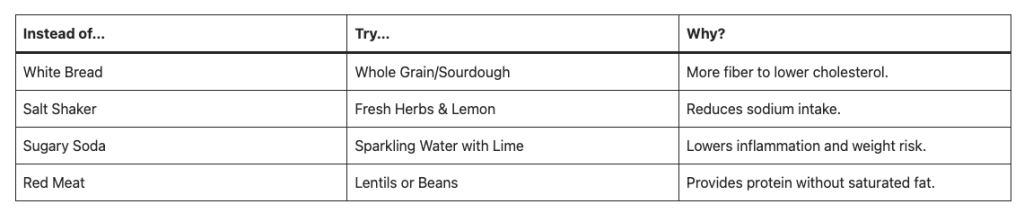
Smart Swaps for Heart Health
Move More, Sit Less
Your heart is a muscle, and like any muscle, it needs exercise to stay strong. The American Heart Association recommends at least 150 minutes of moderate-intensity aerobic activity per week.
Find Your “Flow”: You don’t have to run marathons. Brisk walking, swimming, or strength training.
The Power of 10: If 30 minutes feels daunting, break it into three 10-minute bursts throughout the day.
Prioritize Quality Sleep and Stress Management
Chronic stress and poor sleep are the “silent” enemies of heart health. When you’re stressed or sleep-deprived, your body stays in a state of high alert, which can damage your arteries over time.
The 7-9 Hour Rule: Aim for consistent sleep. Lack of sleep is linked to increased calcium buildup in the arteries.
Mindfulness: Just five minutes of deep breathing or meditation can lower your heart rate and cortisol levels.
Unplug: Set a “digital sunset” an hour before bed to help your nervous system wind down.
Know Your Numbers
Knowledge is power. Many heart issues don’t have obvious symptoms until they are advanced. Schedule a check-up this month to track these four key metrics:
Blood Pressure: Ideally below 120/80 mmHg.
Cholesterol: Monitor your LDL (bad) and HDL (good) levels.
Blood Sugar: High glucose levels can damage blood vessels over time.
Body Mass Index (BMI): Keep a healthy weight to reduce the workload on your heart.
A Note on Smoking: If you smoke or vape, quitting is the single most impactful thing you can do for your heart. Even within one year of quitting, your risk of a heart attack drops significantly.
Small Changes, Big Impact
You don’t have to overhaul your entire life; choose one small change this week—perhaps taking a daily walk or adding a serving of vegetables to dinner. Consistency is the secret to a healthy heart!
Offering voluntary benefits is an excellent way to strengthen your overall benefits package, stand out from competitors, and enhance employee satisfaction—all with minimal impact on your budget. However, while employers often provide a wide range of voluntary benefits designed to offer value and convenience, many employees may not fully understand what these benefits are or how they can help. Educating your workforce about the advantages of voluntary benefits ensures both employers and employees gain maximum value.
Showcasing the Value
Employees may not always recognize the value of voluntary benefits, particularly since these options are typically employee-funded. These benefits, which may include options like life insurance, disability coverage, accident insurance, critical illness insurance, cancer insurance or even legal and pet insurance, provide added security and convenience without significantly increasing employer costs.
For example, voluntary insurance purchased through an employer group is often more affordable than an individual policy—but few employees realize this. When highlighting voluntary benefits, clearly explain the advantages of being covered, the potential risks of going without protection, and the convenience of enrolling through payroll deductions.
Promoting Coverage Understanding
Employee education is vital to preventing confusion and frustration about what a policy covers. Misunderstandings can lead to resentment if employees expect coverage that isn’t actually included. To avoid these situations, ensure every employee—whether their benefit is employer-paid or voluntary—understands how the coverage works.
Consider the following strategies to strengthen benefits education:
Invite current employees to attend orientation or periodic benefits meetings.
Ask benefit providers to send representatives to explain their products directly to staff.
Schedule small-group sessions for employees who have detailed questions.
Leverage social media to share educational materials, reminders, and benefit updates in an accessible way.
Strengthening Employer Value
Beyond increasing participation in voluntary benefits, investing in employee education helps position your organization as a trusted source of benefits knowledge. This approach not only boosts engagement but also strengthens employee satisfaction and loyalty to your company.