On April 23, 2024, the Federal Trade Commission (FTC) finalized a rule banning most employers and employees from entering into non-compete clauses, effective 120 days post-publication in the Federal Register. This move aims to eliminate these clauses across all levels of workers, with a narrow exception for senior executives’ pre-existing agreements.
The rule broadly defines non-compete clauses, including any terms that prevent or penalize employees from seeking employment elsewhere after their current employment ends. It also outlaws “forfeiture-for-competition” clauses, where employees must choose between severance and working for a competitor.
Moreover, the rule mandates that employers notify all employees, except senior executives, that their non-compete clauses are no longer enforceable, providing suggested language for such notifications.
An exception remains for non-compete clauses entered into during the bona fide sale of a business, which now potentially includes certain employee scenarios.
EMPLOYER CONSIDERATIONS
This rule marks a significant shift in U.S. employment practice, and employers are urged to reassess their compensation and retention strategies immediately.
PORTAL OPEN FOR RXDC SUBMISSIONS
On April 10, 2024, the Centers for Medicare and Medicaid Services (CMS) announced through its RegTap portal that the Health Insurance Oversight System (HIOS) is now open to Prescription Drug Data Collection (RxDC) submissions for 2023. Any plan sponsor submitting the RxDC report on its own must be registered with HIOS.
CMS has provided several resources for navigating the registration process:
While this is a one-time registration, the first time can take several weeks, so plan sponsors are encouraged to register early. The 2023 reference year submission is due June 1, 2024.
PREGNANT WORKERS FAIRNESS ACT ISSUED
On April 15, 2024, The Equal Employment Opportunity Commission (EEOC) issued final regulations for the Pregnant Workers Fairness Act (PWFA), effective June 18, 2024. This law mandates that employers with 15 or more employees must handle accommodation requests for pregnancy, childbirth, or related conditions as they would under the Americans with Disabilities Act (ADA).
Key aspects of the PWFA include a broad definition of “pregnancy, childbirth, or related medical conditions” that covers a wide range of situations from fertility treatments to lactation. Employers are required to provide reasonable accommodations, which might include job restructuring, flexible working hours, and modifications to the work environment, among others.
The regulations emphasize that accommodations need not be based on the severity of conditions, and employers can deny accommodations only if they pose an undue hardship, which must be carefully assessed through an interactive process.
EMPLOYER CONSIDERATIONS
Employers should review and update their HR policies and training to ensure compliance with the PWFA, considering any additional local or state regulations.
2024 PRIVACY RULE AMENDED TO STRENGTHEN PROTECTIONS FOR HIGHLY SENSITIVE PHI
On April 22, 2024, the Department of Health and Human Services (HHS) introduced new regulations under the Health Insurance Portability and Accountability Act (HIPAA) to safeguard protected health information (PHI) related to reproductive health care. This action follows concerns that PHI could be misused under new state laws following the Supreme Court’s decision in Dobbs v. Jackson Women’s Health Organization. This regulatory update aims to preserve patient confidentiality and uphold individuals’ rights under shifting legal landscapes in reproductive health.
Key features of these regulations include:
Enhanced P\protection of PHI: The new rule prevents regulated entities, like healthcare providers and health plans, from using or disclosing PHI to investigate or penalize individuals or providers related to lawful reproductive healthcare.
Definition of reproductive health care: The scope covers a broad range of services, including contraception, prenatal care, pregnancy termination, and fertility treatments, among others.
Attestation requirement: Regulated entities must obtain a signed attestation confirming that any request for PHI is not for the purpose of investigating or penalizing lawful reproductive health care.
Updated Notice of Privacy Practices (NPP): Covered entities are required to revise their NPPs to clearly inform individuals about the use and disclosure of their PHI concerning reproductive health care, with updates to be completed by February 16, 2026.
EMPLOYER CONSIDERATIONS
It’s crucial to stay updated with HHS guidance, ensure NPPs are current, and consult legal counsel when handling PHI related to reproductive health care.
HARASSMENT PREVENTION GUIDANCE RELEASED
The Equal Employment Opportunity Commission (EEOC) has recently published final enforcement guidance on workplace harassment. This comprehensive document updates and consolidates previous guidance from 1987 to 1999 into a unified resource that reflects changes in law and evolving workplace dynamics, including virtual environments and the influence of digital technology.
Key highlights of the guidance:
Protection from harassment: It reaffirms that federal laws protect employees from harassment based on race, color, religion, sex, national origin, disability, age (40 or over), or genetic information.
Scope of harassment: Harassment can occur not only between coworkers and supervisors but also through interactions with customers, contractors, and other third parties.
Legal and technological updates: The guidance incorporates recent legal precedents, such as the Supreme Court’s decision in Bostock v. Clayton County and addresses new challenges like online harassment.
EMPLOYER CONSIDERATIONS
Employers should review the Summary of Key Provisions, and consider whether their employees may experience barriers to understanding the law. Employers should:
Have a clear, easy-to-understand anti-harassment policy.
Have a safe and effective procedure that employees can use to report harassment, including more than one option for reporting.
Provide recurring training to all employees, including supervisors and managers, about the company’s anti-harassment policy and complaint process.
Take steps to make sure the anti-harassment policy is being followed and the complaint process is working.
QUESTION OF THE MONTH
Q: If an enrolled employee’s dependent loses coverage and needs to enroll under the employee’s plan, is that an opportunity to switch medical plans and carriers, or are they restricted to their current plan?
A: The employee can enroll the dependent in any plan option offered by the employee’s employer. This is a HIPAA special enrollment right and the right extends to any benefit plan option, even if the employee was not previously on that option.
Here is an example from the HIPAA special enrollment regulations:
Facts. Individual A works for Employer X. X maintains a group health plan with two benefit packages—an HMO option and an indemnity option. Self-only and family coverage are available under both options. A enrolls for self-only coverage in the HMO option. A’s spouse works for Employer Y and was enrolled for self-only coverage under Y’s plan at the time coverage was offered under X’s plan. Then, A’s spouse loses coverage under Y’s plan. A requests special enrollment for A and A’s spouse under the plan’s indemnity option.
Conclusion. In this example, because A’s spouse satisfies the conditions for special enrollment under paragraph (a)(2)(ii) of this section, both A and A’s spouse can enroll in either benefit package under X’s plan. Therefore, if A requests enrollment in accordance with the requirements of this section, the plan must allow A and A’s spouse to enroll in the indemnity option.
This information is general in nature and provided for educational purposes only. It is not intended to provide legal advice. You should not act on this information without consulting legal counsel or other knowledgeable advisors.
In early February, a federal class action lawsuit was filed against Johnson & Johnson (JNJ) and its plan fiduciaries, alleging overpayment for prescription drugs within its prescription drug plan. The complaint alleges that under the Employee Retirement Income Security Act of 1974 (ERISA), JNJ’s plan fiduciaries are obligated to diligently compare service providers, seek cost-effective options, and monitor expenses. It is claimed that the plan fiduciaries failed to act prudently by agreeing to terms with a pharmacy benefit manager (PBM) that resulted in excessive costs for numerous drugs compared to other market options.
The lawsuit highlights the importance of transparency in facilitating comparisons between prescription drug prices across different plans or pharmacies and underscored significant risks faced by health and welfare plan fiduciaries. Publicly available information on drug prices enables individuals – including class action plaintiff attorneys – to scrutinize plan expenses, further emphasizing the need for prudent fiduciary actions.
EMPLOYER CONSIDERATIONS
Given the evolving landscape and heightened litigation risks, health plan fiduciaries should take proactive steps to mitigate litigation exposure and safeguard the interests of plan participants:
Establish a fiduciary committee dedicated to health and welfare benefits and delegate responsibilities accordingly.
Engage qualified consultants to assess PBMs and prescription drug arrangements, ensuring impartiality.
Review and negotiate terms of PBM agreements, fee structures, and formularies to ensure reasonability.
Collect and analyze benchmark information from various sources to evaluate vendor agreements.
Scrutinize compensation arrangements for reasonability and conflicts of interest.
Periodically solicit proposals from PBMs and vendors to reassess market competitiveness.
Document all policies, procedures, and decisions regarding vendor selection and performance monitoring to demonstrate procedural prudence.
UNITEDHEALTHCARE CYBERATTACK IMPACTS MILLIONS
Change Healthcare, a division of UnitedHealthcare’s Optum, was the target of a cyberattack resulting in significant disruptions to prescription orders at thousands of pharmacies nationwide. The impact in the U.S. has been profound, as parent company Optum provides services to more than 60,000 pharmacies and care for more than 100 million consumers.
While it works to recover, the company has isolated services related to billing, claims management, payment, and data exchanges, forcing some healthcare organizations and systems to revert to manual procedures. Full restoration of services remains pending. The American Hospital Association recommended that companies using Optum services temporarily disconnect from them.
Change Healthcare processes approximately 15 billion transactions annually, impacting a significant portion of U.S. patient records, including prescriptions, dental, clinical, and other medical needs. The disruption has led to difficulties in verifying patients’ insurance coverage for prescriptions, forcing some individuals to pay in cash. While larger pharmacy chains like Walgreens have reported limited effects, smaller pharmacies heavily reliant on Change Healthcare for insurance verification and billing services are facing significant challenges.
The attack highlights the vulnerability of healthcare data, especially patients’ private medical records, in the face of cyber threats. Federal officials are closely monitoring the situation, emphasizing the need to strengthen cybersecurity resilience across the healthcare ecosystem.
EMPLOYER CONSIDERATIONS
Given the ongoing disruptions and potential risks to data security, affected employers should:
Remain vigilant and communicate any updates or developments to enrollees.
Encourage employees to exercise caution regarding any unusual communications or activities related to prescription orders or insurance verification.
Stay informed about further updates from Change Healthcare and UnitedHealth Group regarding the restoration of services and any measures to enhance cybersecurity.
UPDATED INSTRUCTIONS RELEASED FOR JUNE 1 RXDC REPORTING
The No Surprises Act, as part of the Consolidated Appropriations Act, 2021 (CAA), requires employer-sponsored health plans to comply with annual prescription drug data collection (RxDC) reporting to provide transparency in prescription drug and health care spending. Data is reported to the U.S. Department of Labor (DOL), the Department of the Treasury (Treasury), and the Department of Health and Human Services (HHS) to monitor spending trends and facilitate regulatory control measures.
The reporting deadline for the 2023 reference year data is June 1, 2024. The Centers for Medicare & Medicaid Services (CMS) has issued revised instructions and templates for RxDC reporting. The instructions are mostly consistent with prior years; however, one significant change is the new enforcement of the “aggregation restriction” beginning with the 2023 reference year. The restrictions will limit the ability of plan sponsors to have their vendors report certain data on their behalf.
Additional changes in the instructions for the 2023 reference year reporting include prescription exclusions and simplified calculations.
Failure to comply with RxDC reporting requirements may result in penalties under Internal Revenue Code Section 4980D of $100 per day.
EMPLOYER CONSIDERATIONS
Ensure timely completion of the RxDC reporting for calendar year 2023 by June 1, 2024.
Confirm filing status with insurance carriers for fully insured plans or follow up with third party administrators (TPAs), pharmacy benefit managers (PBMs), or administrative services only providers (ASOs) for self-insured plans.
Provide necessary information requested by relevant parties for reporting.
Determine whether data should be reported on a plan level or aggregated basis.
Consider requesting pharmacy data reporting on a plan level basis to access detailed pharmacy benefit spend information.
2025 EMPLOYER SHARED RESPONSIBILITY PENALTIES
The IRS has released the 2025 employer shared responsibility payments under the Affordable Care Act (ACA). Applicable large employers (ALEs) may face penalties for failing to provide minimum essential coverage to 95% of full-time employees, or for offering coverage that is not affordable or does not meet minimum value. The adjusted penalty amounts for 2025 will be $2,900 per full-time employee for Penalty “A” (a $70 decrease from 2024) and $4,350 per full-time employee for Penalty “B” (a $110 decrease from 2024).
EMPLOYER CONSIDERATIONS
To avoid penalties, ALEs should consistently ensure full-time employees receive minimum essential coverage that meets affordability and minimum value standards. The IRS uses Letter 226-J to notify ALEs of potential penalties, with a response form included for ALEs to address proposed penalties. Employers and advisors should remain vigilant for this letter to promptly review and respond accordingly.
QUESTION OF THE MONTH
Q: What are the time and dollar limits for flexible spending arrangements (FSA) and FSA carryovers?
A: For 2024, the most that can be deferred to an FSA is $3,200 (a $150 increase from 2023). The amount of a 2024 FSA balance that can be carried over into 2025 is $640 (up from $610 in 2023). A carryover is only available if the FSA does not offer a grace period. The carryover amount can be used all year.
A grace period, on the other hand, is the amount of time in a new year that an employee can incur and be reimbursed for claims from the prior year’s balance. A grace period can be as long as 2 ½ months after the close of the plan year (usually the calendar year). So, if an employee has $1,000 left in the 2023 FSA, that employee could incur $1,000 of reimbursable expense prior to March 15, 2024, and spend that $1,000 if the FSA uses a grace period. An FSA cannot have both a grace period and a carryover.
And finally, most FSAs offer a run-out period. This is a period after the close of the plan year when employees can submit claims incurred in the prior year. There is no maximum run-out period set by the IRS, but most employers (or FSA administrators) will set a limit of 60 to 90 days. The run-out period only allows people to submit claims incurred in the prior year, unlike the grace period, which allows new claims incurred prior to March 15 to be reimbursed.
This information is general in nature and provided for educational purposes only. It is not intended to provide legal advice. You should not act on this information without consulting legal counsel or other knowledgeable advisors.
The Affordable Care Act (ACA) Implementation FAQ Part 63, issued by the U.S. Departments of Labor, Health and Human Services, and the Treasury focuses on the Public Health Service Act, which mandates that non-grandfathered group health plans and health insurance issuers provide culturally and linguistically appropriate summaries of benefits and coverage (SBC) and claims and appeals notices.
The regulations stipulate accommodations for notices in counties where more than 10 percent of the population is literate only in a specific non-English language, as determined by American Community Survey (ACS) data. Plans and issuers must offer oral language services, provide notices in the relevant non-English language upon request, and include a statement in English notices indicating how to access language services (referred to as taglines).
Non-grandfathered group health plans and issuers must adhere to the guidance for plan or policy years beginning on or after January 1, 2025. This guidance ensures that the provision of SBC and claims and appeals notices aligns with cultural and linguistic competence standards.
Employer Considerations
Employers should be prepared to point out to applicable employees the tagline to access language services found in English language SBCs and notices.
REDUCED INSULIN PRICES FOR SOME
UnitedHealth’s pharmacy benefit manager unit, Optum Rx, announced the inclusion of eight insulin products in its reimbursement list, limiting out-of-pocket expenses to $35 or less for enrollees. These products, including short- and rapid-acting insulin from Eli Lilly, Novo Nordisk, and Sanofi will be moved to tier one, the preferred status with the lowest prices, effective January 1, 2024. The move is part of an effort by these major insulin manufacturers, who collectively control 90 percent of the U.S. insulin market, to reduce list prices by 70 to 78 percent this year or in 2024. The Biden administration and lawmakers have been urging insulin makers and pharmacy benefit managers to address the high prices of this crucial medication.
Employer Considerations
Employers should check their insurers’ Rx formulary as more carriers may follow suit to lower insulin prices. Self-funded plans may consider making this change to remain competitive with fully funded plans.
BLUECROSS BLUESHIELD MOVES INTO DIRECT CARE DELIVERY
In 2023, various BlueCross BlueShield (BCBS) plans underwent reorganization, engaging in corporate restructuring, mergers and acquisitions, or establishing subsidiaries focused on healthcare delivery to enhance competitiveness with larger insurers.
BCBS plans have been expanding their presence in healthcare delivery by opening medical clinics exclusively serving their members. In Washington, Premera Blue Cross collaborated with Kinwell Medical Group in 2022 to establish primary care clinics for its members. BCBS Arizona took a similar approach in 2023, launching Prosano Health Solutions, a new primary care subsidiary, with plans to address specific geographic areas in Arizona to improve access to care.
BCBS North Carolina recently announced its intention to acquire 55 North Carolina locations of FastMed, a national chain offering preventive, telehealth, occupational health, primary care, and urgent care services. This move is aimed at enhancing healthcare services, particularly in rural areas with limited access to resources.
Employer ConsiderationsEmployers covered by BCBS should ask their insurance broker whether the carrier provides a direct care option near them.
CALIFORNIA TAKES A STEP TOWARD SINGLE-PAYER SYSTEM
Governor Gavin Newsom signed Senate Bill 770, a significant step toward universal healthcare in California. The legislation directs the state’s Health and Human Services Agency to collaborate with the federal government to create a unified health financing system for all Californians. This move could pave the way for a single-payer system, covering every resident and funded by state and federal resources, including Medicaid and Medicare funds.
Senate Bill 770 aims to establish a uniform standard of healthcare accessible to all individuals, irrespective of factors such as age, income status, employment status, immigration status, and other variables. As California undergoes modifications in its Medi-Cal system, Michael Lighty, president of Healthy California Now, emphasizes that certain persisting issues can only be effectively addressed through comprehensive reforms across the entire healthcare system.
The law requires California’s health secretary to provide recommendations on crafting a federal waiver by June 1, 2024, potentially allowing the state to access federal financing for a universal healthcare system.
While the legislation faced opposition, including criticism from both the left and the right, it suggests an incremental approach to healthcare reform in California. The move aligns with Governor Newsom’s 2018 campaign promise of supporting a single-payer system. Despite the diverse opinions, the signing of SB 770 underscores California’s commitment to exploring avenues for achieving universal healthcare.
On November 9, 2023, Chicago replaced its existing paid sick leave ordinance with the Chicago Paid Leave and Paid Sick and Safe Leave ordinance, effective December 31, 2023. The new ordinance modifies the accrual system, allowing employees to earn one hour of paid sick leave plus one hour of paid leave for every 35 hours worked, with a yearly maximum of 40 hours of each. Employees can carry over 16 hours of accrued paid leave and 80 hours of accrued sick leave to the next benefit year. Alternatively, employers can front-load 40 hours of each at the start of each benefit year.
Unlike the prior ordinance, the new law mandates that accrued, unused leave be paid to employees upon termination or when no longer covered by the ordinance, subject to a phased approach based on employer size. Any excess leave beyond annual carryover limits is forfeited. New employees become eligible for paid sick leave after 30 days and paid leave after 90 days of employment. Paid leave can be used for any purpose, and employers cannot compel employees to disclose the reason.
Employer Considerations
Employers must comply with various notice and posting requirements, including providing written notice of the paid-time-off policy at the start of employment and before any changes. A 14-day notice of policy changes affecting final compensation must be given, and information about leave accrual and usage must be provided with each wage payment. Employers with Chicago-based employees should carefully review and adjust their sick leave and paid leave policies to align with the new ordinance, considering its differences from the previous paid sick leave ordinance and the upcoming statewide Paid Leave for All Workers Act.
QUESTION OF THE MONTH
Q: Can former employees who are on COBRA and paying monthly premiums to a TPA for COBRA deduct those premium amounts on their taxes? For example, if a person is on COBRA for three months in 2023, can they deduct COBRA premium payments from taxable income on their 2023 federal tax return?
A: Yes, COBRA premiums can be deducted on an individual’s federal income taxes provided they itemize their taxes and the person’s medical expenses (including COBRA premiums) exceed 7.5% of their adjusted gross income.
Answers to the Question of the Week are provided by Kutak Rock LLP. Kutak Rock provides general compliance guidance through the UBA Compliance Help Desk, which does not constitute legal advice or create an attorney-client relationship. Please consult your legal advisor for specific legal advice.
This information is general in nature and provided for educational purposes only. It is not intended to provide legal advice. You should not act on this information without consulting legal counsel or other knowledgeable advisors.
PROPOSED CHANGES TO SHORT-TERM, LIMITED-DURATION INSURANCE
On July 7, 2023, the U.S. Department of Health and Human Services (HHS), the Department of Labor (DOL), and the Department of the Treasury proposed changes to modify the definition of short-term, limited-duration insurance (STLDI) and the conditions for fixed indemnity insurance to be considered an excepted benefit. The proposal also asks for comments on specified disease plans and level-funded plans. The proposal looks to clarify the tax treatment of certain benefit payments under group health plans.
Short-term, limited-duration insurance is meant to fill temporary gaps in coverage during transitions. The proposal suggests limiting the initial contract period to no more than three months and the maximum coverage period to no more than four months, including renewals. This change aims to differentiate STLDI from comprehensive coverage and reduce financial risk for individuals using it as a long-term alternative.
The proposal also forbids the same issuer from issuing multiple STLDI policies to the same policyholder within a year (known as “stacking”). STLDI sales mainly occur through group trusts or associations, and the proposal clarifies that such sales are not group coverage for federal law purposes.
Fixed indemnity plans provide income replacement rather than full medical coverage. The proposed regulations look to clarify that this coverage should not pay benefits on a per-service basis, to avoid mimicking comprehensive coverage without providing the same consumer protections. The proposal also includes payment standards for fixed indemnity plans and clarifies that such coverage must be offered independently without coordination with other health plans.
Consumer notices would provide clearer information on the differences between STLDI, fixed indemnity excepted benefits coverage, and comprehensive coverage.
PCORI FEE PAYMENT
Plan sponsors of self-funded medical plans, including health reimbursement arrangements (HRAs), were required to report and pay fees to the Patient-Centered Outcomes Research Institute (PCORI) by July 31. This fee on group health plans was created through the 2010 Patient Protection and Affordable Care Act (ACA).
Research funded by PCORI concentrates on healthcare challenges faced by families every day, including cancer, diabetes, maternal mortality, opioid addiction, mental health, and equitable access to care, among many others.
If you believe you should have paid this fee, contact your broker for information, and access additional information including Form 720 for to submit the fee.
GROUP HEALTH PLANS ENCOURAGED TO EXPAND ENROLLMENT PERIOD FOR INDIVIDUALS LOSING MEDICAID AND CHIP
In a letter dated July 20, 2023, from the Center for Medicare and Medicaid Services (CMS) to employers, plan sponsors, and issuers, the Biden Administration encouraged these entities to offer additional enrollment opportunities in group health plans for employees and their dependents who are losing coverage under Medicaid.
The U.S. is experiencing a health coverage transition due to the COVID-19 pandemic. The pause on Medicaid coverage verifications and terminations ended on March 31, 2023, and state Medicaid agencies are now resuming regular eligibility and enrollment operations, which include renewing coverage for eligible individuals and terminating coverage for those no longer eligible.
According to a Department of Health & Human Services report, about 3.8 million individuals who lose Medicaid eligibility could be eligible for employment-based coverage. The Administration believes that many people may need more than the typical 60-day window after losing Medicaid or Children’s Health Insurance Program (CHIP) coverage to apply for and enroll in other coverage, especially considering the unique circumstances surrounding the resumption of Medicaid and CHIP renewals.
To address this concern, CMS has announced a temporary special enrollment period on HealthCare.gov. Marketplace-eligible individuals who lose Medicaid or CHIP coverage and come to HealthCare.gov between March 31, 2023, and July 31, 2024, will be able to enroll. Employers are encouraged to follow suit by expanding special enrollment periods for individuals losing Medicaid or CHIP coverage. These changes would require a plan amendment and approval from the insurance carrier.
Employers interested in sharing this with employees should provide information about Medicaid and CHIP renewals to employees and encourage them to update their contact information with their state agency, using CMS resources available at www.medicaid.gov/unwinding. Employers can voluntarily open enrollment in their employment-based plan for those losing Medicaid or CHIP coverage.
PROPOSED RULES MAY IMPACT MHPAEA AND NQTL DATA COLLECTION
On July 25, 2023, the U.S. Departments of Treasury, Labor, and Health and Human Services (the “Departments”) issued a comprehensive set of guidelines to help employers comply with the requirements of the Mental Health Parity and Addiction Equity Act (MHPAEA). The guidelines, including definitions and examples, emphasize the importance of access to mental health and substance abuse treatment, and data collection for the production of analysis reports.
A new rule focuses on networks having an adequate number of appropriate providers. Low reimbursement rates for behavioral health care providers compared to primary care providers negatively impact access to care. Plans must collect and analyze network adequacy data and provider reimbursement rates to address this issue.
The guidelines also establish specific content and delivery requirements for the non-quantitative treatment limitations (NQTL) comparative analysis and set minimum data collection standards. The Departments expressed dissatisfaction with the current state of plans compliance with the NQTL analysis requirements and aim to bridge the gap with the proposed regulations.
These regulations are still in the proposal stage, and incoming comments may lead to modifications. Employers should review the guidelines with their brokers, paying particular attention to their network providers, as access to mental health and substance abuse disorder care is a top priority.
QUESTION OF THE MONTH
Q: My staff count has been fluctuating around 50 for some time. How do I know if or when I need to offer health insurance to my employees?
A: Whether an employer is an applicable large employer (ALE) is determined each calendar year, and generally depends on the average size of an employer’s workforce during the prior year.
If an employer has fewer than 50 full-time employees, including full-time equivalent employees, on average during the prior year, the employer is not an ALE for the current calendar year and therefore not subject to the employer shared responsibility provisions or the reporting provisions for the current year.
If an employer has at least 50 full-time employees, including full-time equivalent employees, on average during the prior year, the employer is an ALE for the current calendar year, and is therefore subject to the employer shared responsibility provisions and the reporting provisions.
This information is general in nature and provided for educational purposes only. It is not intended to provide legal advice. You should not act on this information without consulting legal counsel or other knowledgeable advisors.
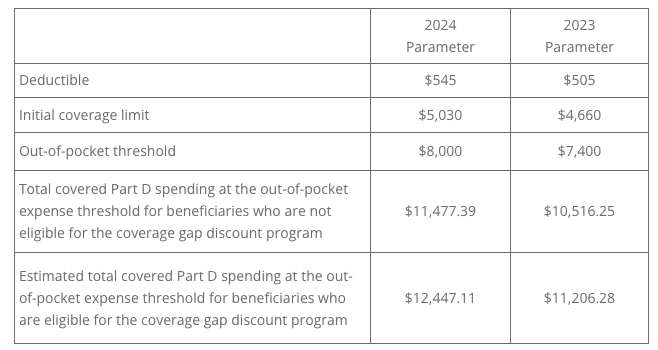
2024 BENEFIT PARAMETERS FOR MEDICARE PART D CREDITABLE COVERAGE DISCLOSURES ANNOUNCED
The Centers for Medicare and Medicaid Services (CMS) released a Fact Sheet announcing the 2024 benefit parameters for Medicare Part D. These factors are used to determine the actuarial value of defined standard Medicare Part D coverage under CMS guidelines.
Each year, Medicare Part D requires that employers offering prescription drug coverage to Part D eligible individuals (including active or disabled employees, retirees, COBRA participants, and beneficiaries) disclose to those individuals and CMS whether the prescription plan coverage offered is creditable or non-creditable. Creditable coverage meets or exceeds the value of defined standard Medicare Part D coverage.
Insurance carriers and providers of the prescription benefit will typically notify the plan sponsor if their prescription plan is creditable or non-creditable. The 2024 parameters for Medicare Part D are:
The Online Disclosure to CMS Form must be submitted to CMS annually, and upon any change that affects whether the drug coverage is creditable:
Within 60 days after the beginning date of the plan year
Within 30 days after the termination of the prescription drug plan
Within 30 days after any change in the creditable coverage status of the prescription drug plan
QUESTION OF THE MONTH
Q: Where can I find the updated RxDC reporting instructions?
To receive an email when the instructions are updated, create a Registration for Technical Assistance Portal (REGTAP) account. Select the checkbox “Please send me updates for the Consolidated Appropriations Act / No Surprises Act” in your account settings.
This information is general in nature and provided for educational purposes only. It is not intended to provide legal advice. You should not act on this information without consulting legal counsel or other knowledgeable advisors.