by admin | May 12, 2026 | Custom Content, Employee Benefits
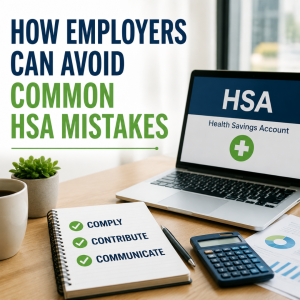
High Deductible Health Plans (HDHPs) paired with Health Savings Accounts (HSAs) remain a cornerstone of modern benefits strategy. When executed correctly, they offer a powerful “triple tax advantage” for employees and lower premiums for employers. However, the federal rules governing these accounts are strict.
As we move into the 2026 plan year—and navigate new permanent changes brought on by the One Big Beautiful Bill Act (OBBBA)—it is critical for employers to audit their compliance to avoid costly excise taxes and employee relations issues.
- Verify Your HDHP Status (2026 Limits)
To be HSA-eligible, a health plan must meet specific IRS definitions for “High Deductible.” For plan years beginning in 2026, ensure your plan design matches these updated thresholds:
- Minimum Deductibles: $1,700 (Self-only) / $3,400 (Family)
- Out-of-Pocket Maximums: $8,500 (Self-only) / $17,000 (Family)
Crucial Check: If your family plan uses “embedded” deductibles, the individual deductible within the family plan cannot be lower than the family minimum of $3,400.
- Prevent FSA/HRA Disqualification Issues
An employee is generally ineligible to contribute to an HSA if they are covered by a general-purpose Flexible Spending Account (FSA) or Health Reimbursement Arrangement (HRA).
- The Grace Period Risk: If an employee has a remaining balance in a general-purpose FSA with a grace period, they cannot contribute to an HSA until the grace period ends.
- The Carryover Solution: To preserve HSA eligibility, employers should allow employees to either waive their FSA carryover or transition those funds into an “HSA-compatible” (Limited Purpose) FSA.
- Master the 2026 Contribution Limits
While employees are responsible for their own tax filings, employers play a vital role in preventing “excess contributions” through payroll.
- 2026 Limits: $4,400 (Self-only) / $8,750 (Family).
- Age 55+: Catch-up contributions remain a vital tool but require careful tracking.
- Correction Window: If a mistake is made, employees must distribute the excess funds by April 15 of the following year to avoid a cumulative 6% excise tax.
- Special Alert: Medicare and Age 65
Medicare eligibility is a common source of HSA compliance errors. Once an individual enrolls in any part of Medicare, they can no longer contribute to an HSA.
- The Retroactive Rule: If an employee applies for Medicare more than six months after turning 65, their coverage (and HSA ineligibility) may be backdated up to six months.
- Employer Action: Inform employees approaching age 65 to plan their “contribution stop date” carefully to avoid unintended tax penalties.
- Leverage Permanent Telehealth Flexibility
Because of the OBBBA (Notice 2026-5), the temporary “safe harbor” for telehealth has been made permanent. HDHPs can now provide first-dollar coverage for telehealth and remote care services before the deductible is met without disqualifying the HSA.
Why this matters: Incorporating pre-deductible telehealth reduces time away from work, increases productivity, and lowers overall claims costs by catching minor issues before they require an ER visit.
Compliance Resources
For personalized assistance auditing your 2026 plan design, contact us today.
by admin | Mar 2, 2026 | Custom Content, Employee Benefits, Health Insurance
Choosing a health insurance plan can feel a lot like solving a puzzle—there are many moving pieces, and the best fit depends on how they come together for your unique situation. With so many options and acronyms—HMO, PPO, POS, EPO, HDHP—it’s easy to feel unsure about where to start. This guide breaks down the most common types of health plans to help you understand how they work, what they cost, and which one might align best with your health care needs and budget.
What Sets Health Plans Apart
When comparing plans, pay attention to these key differences:
- Whether you must choose a Primary Care Provider (PCP)
- If you need referrals to see specialists or get certain services
- Whether the plan requires preauthorization for certain procedures
- If out-of-network care is covered
- How much cost sharing you’re responsible for (deductible, copay, coinsurance)
- Whether you’ll need to file claims or handle additional paperwork
No single plan works for everyone. The right choice depends on your personal health needs, your family’s situation, and your financial comfort level.
Health Maintenance Organization (HMO)
An HMO plan typically offers lower premiums, smaller deductibles, and predictable copays. In exchange, you’ll need to stay within the plan’s provider network and work through a designated PCP, who must refer you to specialists.
HMOs can be a cost-effective option for individuals with fewer health care needs who are comfortable with a structured system.
Preferred Provider Organization (PPO)
PPO plans allow more flexibility when choosing health care providers—you can see specialists and even out-of-network doctors without referrals. These plans usually have higher premiums, and out-of-network care costs more.
A PPO may be a good fit if you want freedom to choose your providers and anticipate needing multiple types of care.
Point-of-Service (POS)
POS plans blend features of both HMOs and PPOs. You’ll select a PCP but can also choose out-of-network care at a higher cost. For slightly higher premiums than an HMO, POS plans provide flexibility while encouraging coordinated care through your PCP.
A POS plan can work well if you want both structure and the occasional freedom to go out-of-network.
Exclusive Provider Organization (EPO)
An EPO plan offers moderate flexibility. Like an HMO, you must use in-network providers, but unlike an HMO, you usually don’t need a referral to see a specialist. Premiums fall between HMO and PPO rates.
An EPO might be right for you if you’re comfortable with a limited provider network and want easier access to specialists.
High Deductible Health Plan (HDHP)
An HDHP can be structured as an HMO, PPO, POS, or EPO. These plans feature lower premiums but higher deductibles—meaning you’ll pay more upfront before coverage kicks in. HDHPs are often paired with a Health Savings Account (HSA), which lets you set aside pre‑tax dollars for medical expenses and roll over unused funds year to year.
HDHPs can work well for those who don’t anticipate frequent medical needs, such as younger or healthier individuals, but they may not be ideal for those with ongoing health concerns.
Final Thoughts
Because health plans and rules can vary by state (and employer), take time to review the details carefully before enrolling. Understanding the coverage, costs, and flexibility of each option will help you make an informed, confident decision that fits your unique health and financial needs.

by admin | Aug 4, 2025 | Custom Content, Employee Benefits
Employers will see several changes to their health and welfare benefits due to comprehensive new tax and spending legislation. This includes notable improvements to Health Savings Accounts (HSAs), Dependent Care Flexible Spending Arrangements (DCFSAs), and employer-provided student loan payments, as well as the introduction of some new fringe benefit choices.
These updates introduce significant changes to employee benefits. These changes are part of a comprehensive legislative package enacted on July 4, 2025 and will require employers and employees to adjust their understanding and utilization of benefit programs. Some of the most notable provisions are:
- Health Savings Accounts (HSAs) can now cover Direct Primary Care (DPC) fees, up to $150/month for individuals and $300/month for families.
- The telehealth exception for high-deductible health plans (HDHPs) is now permanent, ensuring continued access to virtual care. Employees with HDHPs will have first-dollar coverage of most telehealth services, before meeting their HDHP deductible.
- The dependent care FSA limit has increased from $5,000 to $7,500 ($3,750 for married filing separately), a boost for working parents.
- Bronze and catastrophic ACA exchange plans are now HSA-qualified.
- The tax exclusion for employer-sponsored health insurance remains intact, a win for traditional group benefits.
- Permanent exclusion for student loan assistance allows for a tax exclusion of up to $5,250 per year for employer payments of student loans and offers long-term support for employees managing student debt.
- New tax-advantaged accounts for children (a.k.a. “Trump Accounts”) are individual retirement accounts (IRAs) for children under 18 with an annual contribution cap of $5,000. These accounts allow for employers to contribute up to $2,500 per employee. Additionally, children born between January 1, 2025, and December 31, 2028, are eligible to receive a one-time $1,000 government contribution.
These changes are important as they significantly impact the employee benefits landscape. They also enhance access to care, reduce wait times, and provide greater flexibility, cost savings, and options for both employers and employees. By leveraging these updates, organizations can elevate employee well-being while remaining tax-compliant and strategically competitive.

by admin | Aug 7, 2018 | Group Benefit Plans, Hot Topics
Q.For a high deductible health plan (HDHP) to qualify for health savings account (HSA) eligibility, what is the minimum amount that an embedded individual deductible can be?
A.For 2018, the embedded individual deductible must be at least $2,700. For an HDHP to qualify for HSA eligibility, an individual with family coverage would need to satisfy the required minimum annual deductible for family HDHP coverage (which is at least $2,700 for 2018) before any amounts are paid from the HDHP.

by admin | Jun 20, 2018 | Employee Benefits, IRS
According to recent estimates by Fidelity Investments, a couple will incur an estimated $280,000 worth of medical expenses after turning 65 years of age. They estimate this cost every year and when they publish it, I can’t help but have an anxiety spike as I ponder the reality of that number. Even if they are off and have over-estimated by 50%, the remaining number is still very hard for me to swallow. And, as anxiety has habit of doing, it sends me into panic mode and I scramble to reevaluate my retirement planning in an attempt to ward off the eventual doom and gloom that has settled on the far horizon of my life.
After a few deep breaths, I settle down and remind myself that I have a health savings account (HSA) that I have faithfully been contributing to over the past several years and that I plan to continue contributing to as long as I am eligible to do so. HSAs are a great way to plan for medical expenses, either in the future when you retire, or now when you or a member of your family incurs qualified medical expenses. Here’s the run down on how they work.
HSAs are a savings account option that allows individuals that are covered by a high deductible health plan (and that are not covered by any type of insurance other than a high deductible health plan), to set aside a certain amount of their income on a pre-tax basis to pay for medical expenses that arise. Unlike health flexible spending accounts that are similar in that individuals can set aside pre-tax dollars to pay for qualified medical expenses, funds put into an HSA are not forfeited at the end of the year if you don’t spend them. Said differently, HSAs don’t have the “use it or lose it” component. If you don’t use it, you keep it, and if you do that year after year, the balance in your HSA can grow exponentially!
An HSA works essentially like this. Each year the government sets a maximum amount that qualified individuals are able to put into an HSA on a pre-tax basis. For 2018, this amount is set at $3,450 for individuals that have single coverage under a high deductible health plan (HDHP) or $6,900 for individuals with family coverage under an HDHP plan. Then, these funds can be used to pay for qualified medical expenses that are incurred. This would be for out-of-pocket expenses that aren’t covered by their health plan such as copays, deductibles or qualified expenses not covered by the plan.
The concept for HDHPs is that they are a type of consumer-driven health plan that results in individual consumers having more “skin in the game,” leading them to be more conscientious consumers of health care, thereby helping to control the rising costs of health care. To assist individuals to pay for the higher costs they are responsible for prior to meeting the higher deductible, the government was willing to also have more skin in the game by forfeiting tax dollars and allowing HSA contributions to be made on a pre-tax basis to pay for these costs. Employers who allow employees to contribute to HSAs on a pre-tax basis also benefit by reducing the amount of FICA taxes that they are required to pay.
The goal of the HSA was not only to help pay for these higher, pre-deductible expenses, but also to provide a mechanism for individuals to save for medical expenses once they reach retirement. After all, discussions and debates continue regarding whether or not Medicare will continue to exist in the years to come.
If you contribute to an HSA and then use those funds for qualified medical expenses, you pay no taxes on those funds. In essence, you are lowering your expense by the amount of taxes you save. If, however, you dip into your HSA to pay for non-qualified expenses, then you are subject to taxes on those funds plus a 10% tax penalty.
Some individuals balk at contributing to an HSA because they feel they will not incur qualified medical expenses in the coming year. Other individuals limit their HSA contributions to the amount of qualified medical expenses they expect to incur in the coming year. Still others try to contribute the maximum amount each year regardless of what they anticipate their costs being. Why?
In addition to contributing dollars on a pre-tax basis, many banks that offer HSAs also offer investment options for those accounts, so that you can increase your funds through investments on top of the on-going contributions that you deposit. And, this investment growth is also available to you on a tax-free basis as long as the funds are used for qualified medical expenses! I find this refreshingly reassuring as I peek into my account and see that it is growing, and it not just because I’m dumping money into it. So max-funding an HSA and investing those dollars allow you to earn even more dollars on top of the pre-tax dollars. I look at this as free money!
Because of this growth potential, leaving funds in the account even when you do have qualified medical expenses can be an advantageous investment maneuver. What? Not use the funds when you have a qualified expense? Yep. You are not required to take funds out of your HSA at the time that a qualified expense occurs. You can leave that money in your HSA and, as long as you keep your receipts showing that you paid for those qualified expenses, you can wait to reimburse yourself for that expense at any time in the future, even if you are no longer covered by an HDHP when you decide to reimburse yourself. You see, although you are only eligible to contribute to an HSA when you are covered by an HDHP, you can take the money out for qualified expenses at any time in the future. I love this option. I put as much money into my HSA as I can, and as long as I have the funds in my personal operating account, I pay for qualified medical expenses with that money. I save all of those receipts and if in the future I’m short on money in my operating account for whatever reason, I can then reimburse myself for prior qualified medical expenses from my HSA. If I never need to do this, good for me; I leave the funds in the HSA and I continue to reap investment growth. There’s that free money again!
But what if I reach retirement and I’m still healthy? What if I manage to accumulate $140,000 in my HSA and I end up NOT having $140,000 in medical expenses? Will I encounter a “use it or lose it” option at this point? Nope. If I’m fortunate enough to be healthy with minimal medical expenses after turning 65, the funds in my HSA can operate exactly like my 401(k). Meaning, if I withdraw the funds for non-medical expenses after turning 65, those funds are subject to taxes, but they are no longer subject to the 10% tax penalty that I would have incurred if I used the funds for non-medical expenses prior to turning 65. And, just like a 401(k), the anticipated tax rate after I turn 65 is expected to be lower so I won’t pay as much in tax as I would have if I had taken those funds in my paycheck back when I was younger. Although my goal is to contribute to both my 401(k) and my HSA, I try to max-fund my HSA first and then I fund my 401(k) with as much as I can after that. Why? Because, once I reach 65 my HSA performs just like my 401(k) if I choose to spend the dollars on non-medical expenses. However, if I do have medical expenses, the funds I take from my HSA to pay for those expenses are “tax-free.” If I had to use money from my 401(k) for medical expenses, that money would be taxed!
By Vicki Randall
Originally Published By United Benefit Advisors